|
Selenae or selenic bodies (from the name of the ancient Greek moon goddess Selene) are lifeless worlds with extremely rarefied atmospheres. In such worlds any atmosphere that has not gotten completely stripped away by solar winds usually stays very close to the ground and is in some cases replenished by various sources:
For mankind the most prominent example of a selena is the only moon of Earth itself, which is named Luna. Another example is Mercury, the smallest and innermost planet of the Sol system. The almost total absence of atmosphere means that the surface of a selenic world is usually well preserved, as neither the erosive forces of weather nor the cyclical movement of liquids exert their influence on these planets. This also means that the craters left by the impacts of meteorites remain unchanged for very long periods of time. Because impact craters accumulate at a nearly constant rate, counting the number of craters per unit area can be used to estimate the age of the surface.[2] Another consequence of the lack of atmosphere are the significant fluctuations in temperature that can be measured on selenic worlds, depending on whether the surface is irradiated or not. |
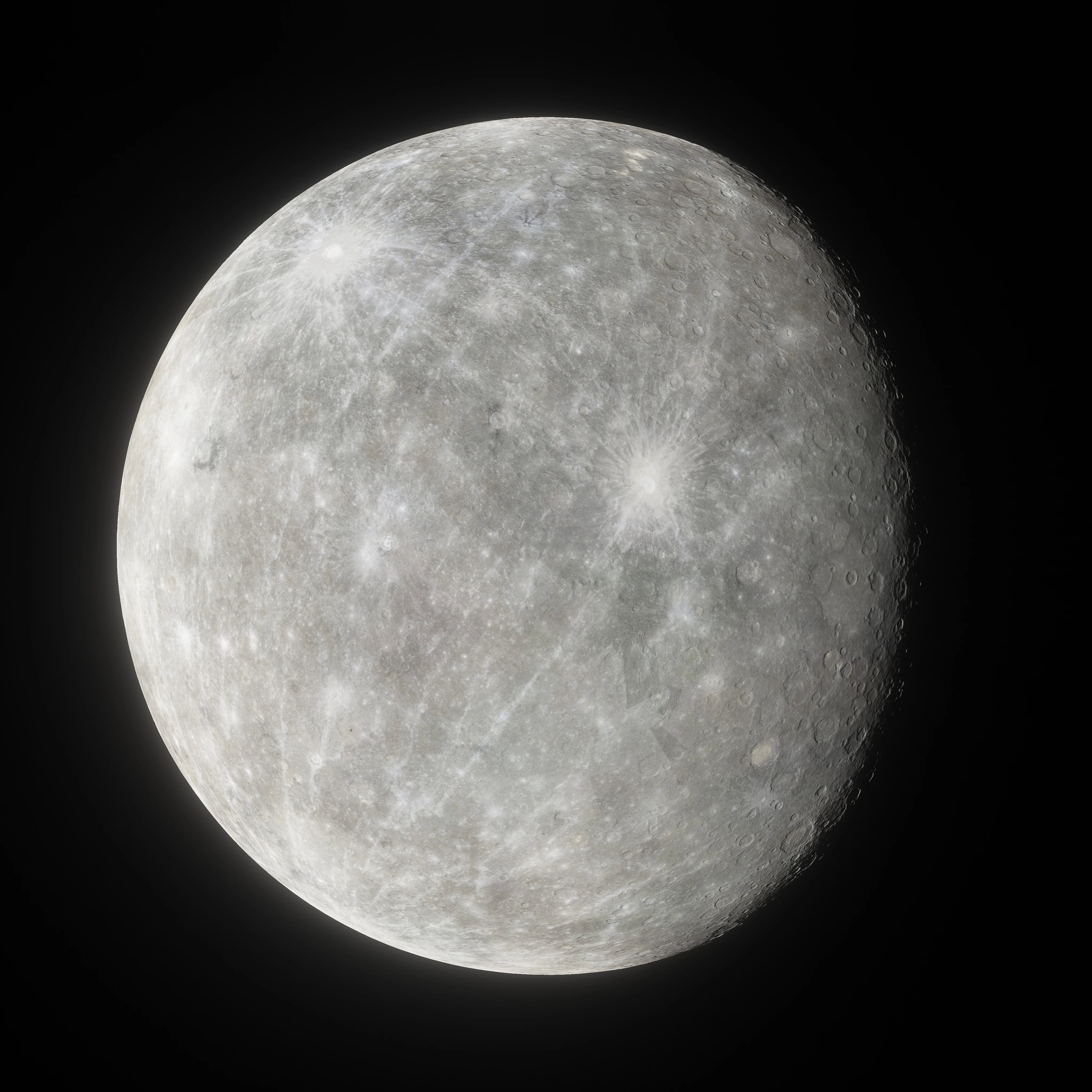 View of Mercury, a selena orbiting in close proximity to Sol.
|
