Viy is the fifth planet of the Hypnos system. Its located roughly 44 au from its star, which in our system would be farther than Pluto, yet here on such a distance you get a temperature of 506 *C, making Viy the fifth hottest planet.
Viy is 4308 km in diameter, larger than Io but smaller than Callisto, simmilar to Simargl's satellite Atar. The mass of Viy is 0.03 earth masses, but mistakenly first read as 0.003, and then VIy was considered less massive than Koshchei.
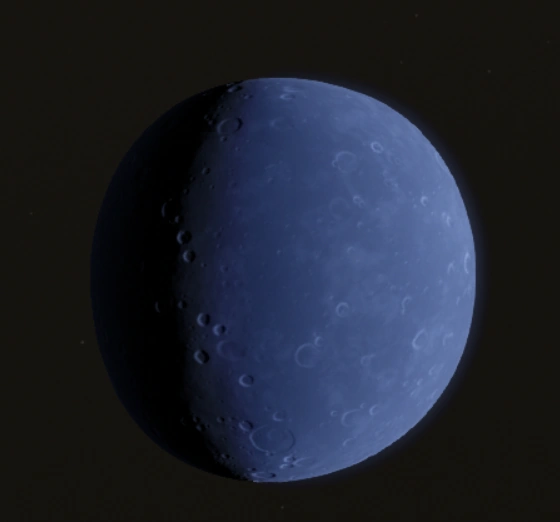
Viy's surface is very simmilar to Koshchei's, they almost definitely share common descent, both are the same shade of blue and with the same brown spots, they are likely atleast made of the same materials. Viy has more craters than Koshchei, despite none of them having atmospheres.
It has five satellites, which are very simmilar to each other, all lookng like copies of each other, however they are darker blue and not simmilar to Viy, Viy is more simmilar to Koshchei and its satellite Zarya than to its own satellites.
Name
Viy in slavic mythology is a character whose stare kills. Interestingly, according to slavic mythology Koshchei is a son of Viy, and these two planets might have common descent. Four of Viy's satellites are named after the other kids of Viy, the fifth one's named Zhar, from Zhar-ptitsa, which in some tales is also a son of Viy.
Physical characteristics
Viy is the second smallest planet in the system, and smaller than three satellites: Rarog, Svetovid and Nav. Its almost 2x smaller than Veles, but also almost 2x larger than Koshchei.
Viy is a koviztoid - an object thought to have formed from a huge super earth that existed in the past but was destroyed by Simargl's migration, and the debris of which formed the modern planets Koshchei, Viy, Zarya, and some satellites of Veles.
Viy has a mass of 0.03 earths, 5x more massive than Koshchei, but less than 2x larger. Viy's density is almost 5 g/cm3, making it the densest koviztoid. While Koshchei is thought to come from Kovizt's core, Viy came from its mantle. Just like other koviztoids Viy has an oblateness so low you can say its 0. Also it has an albedo of 0.3 like all other koviztoids. Just like other koviztoids the difference between its gravity on poles and on equator is very low.
A solar day on Viy is 28 hours 32 minutes and 56 seconds long, having a low rotation like other koviztoids. Like other koviztoids, it has a very small range of speeds its satellites can orbit at - between 2.54 and 3.59 km/s to not fall on the planet or escape. However its still more than other koviztoids, which is most likely what let it kidnap its 5 rocks as satellites.
Just like other koviztoids Viy's effective temperature is the same as its temperature overall - 535 *C. This also tells us it has no atmosphere (which we knew without that) and that it has no significant internal heat source.
Orbital characteristics
Viy's eccentricity is 0.045, an almost perfectly circular orbit, like that of other intependent koviztoids, but with an inclination of 1.55*. It takes 25.5 years to complete one rotation around Hypnos with its semi-major axis of 41.4 au, its perihelion is 39.55 au. As of October 1, 2025, its almost exactly 40 au away from Hypnos, closer to its perihelion.
Atmosphere
Doesnt have one :D
Satellites
Viy's satellites likely all come from some sort of an asteroid belt that used to exist, or still exists but isnt discovered, in the Hypnos system. They all look like they were made with Ctrl+C and Ctrl+V. However, Viy is very different from them, closer to Koshchei's satellite Zarya than to its own satellites. Viy likely kidnapped these satellites from that hypothetical asteroid belt during migration in the early system.
All of Viy's satellites are tidally locked to the planet.
Although initally thought to, none of Viy's satellites are in hydrostatic equillibrium.
All of its satellites are located insanely close. three are even closer than Charon to Pluto, which is very close. Also all of Viy's satellites are hotter than Viy itself, being at ~530 *C while Viy itself at 507. It is not known what causes this, since Viy does not have an atmosphere which could cool it down.
Baba Yaga
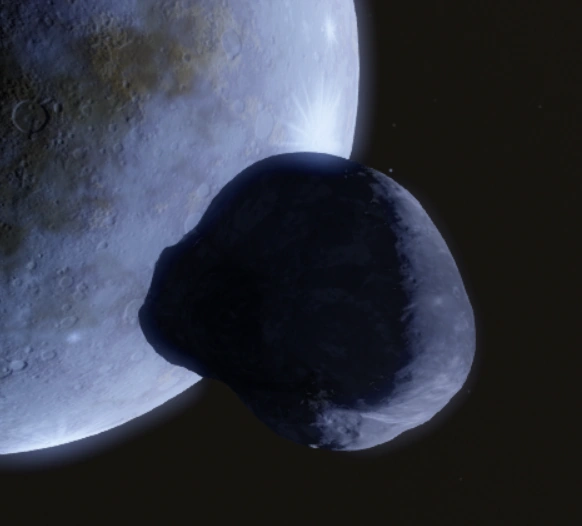

Baba Yaga or SHV1 is the first satellite of Viy, named after his first kid. It is a hot asteroid and looks like any normal asteroid, but dark blue in color. The largest crater on Baba Yaga is ironically named "Metla" - from russian "broomstick" which is what Baba Yaga flies on. The crater cant be seen on the image.
The Broomstick Crater has more smaller craters inside of itself, recursive craters, my guys.
Baba Yaga is 19.91 km in diameter, three Uranus satellites have a simmilar size: Margaret, Ferdinand and Cupid.
Baba Yaga's mass is 2.1707*10-10 earth masses. Its inclination is litteraly zero, not even a single millisecond. Its ESI is 0.03. The semi major axis of Baba Yaga is just 7000 km.
Gorynya
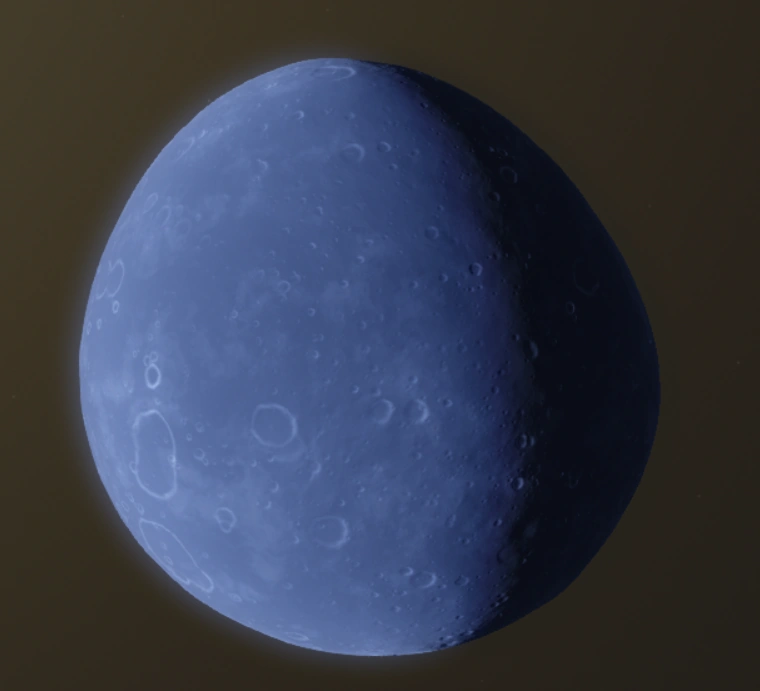

Gorynya
Gorynya is the second satellite of Viy, named after Viy's second son. Gorynya is an egg-like asteroid, initially, from afar, it was mistaken to be in hydrostatic equillibrium.
It is 424.47 km in diameter, slightly larger than Proteus. It is possible to collapse into hydrostatic equillibrium in the future, if the short 4 million years left for the Hypnos system before the entirety of it is completely destroyed by the star's supernova with not even a black hole or neutron star left are enough.
Gorynya's semi major axis is 13 000 km.
Dubynya
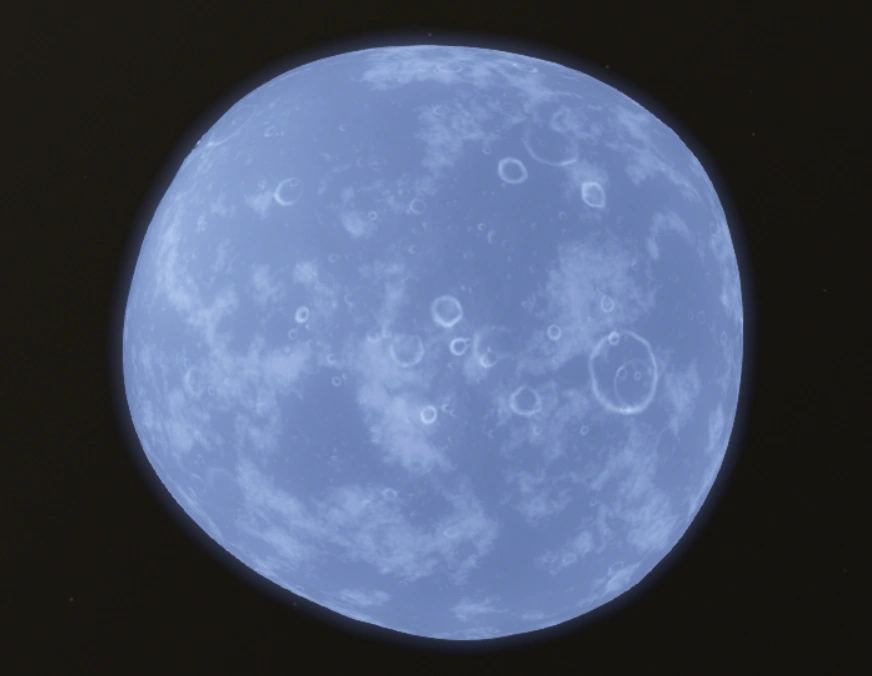

Dubynya
Dubynya is the third satellite of Viy by distance, it resembles Proteus by its form, it is 358 km in diameter, less than Mimas, more than Nereid. Its ESI is 0.16, semi-major axis is ~20 000 km.
Usynya
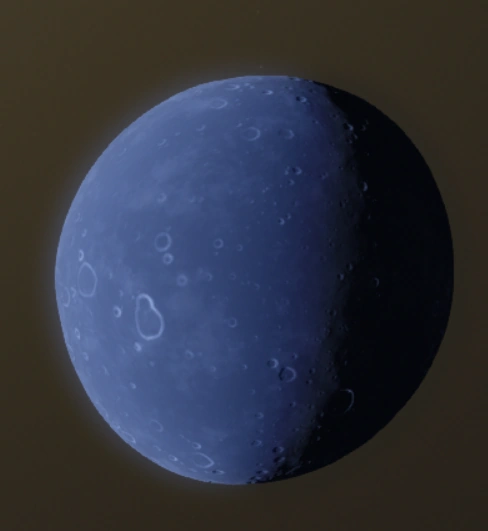

Usynya from an angle that shows the unevenness preventing it from being round
Usynya is the fourth satellite of Viy by distance, and it is INSANELY close to hydrostatic equillibrium, just one unevenness away from being completely round.
Usynya is 490.93 km in diameter, larger than Miranda and Mimas, which are both in hydrostatic equillibrium. Its ESI is 0.156, slightly less than that Dubynya's 0.159.

SHV5
Usynya's semi major axis is 31 000 km.
Zhar
Zhar is 460 km in diameter and looks like a stretched square. Its semi major axis is 48235 km, it also has the largest craters, likely due to being less protected by Viy.
Zhar, just like Usynya and Dubynya, might collapse into hydrostatic equillibrium in the future, as it is larger than Mimas, which is in hydrostatic equillibrium.
For a long time Zhar only had its provisional designation SHV5, it only got a name on October 4, 2025.
are they koviztoids
Other than the light blue-brown color, we have some other traits to identify koviztoids, which show us Viy's moons are not koviztoids.
- Koviztoids have a bond albedo of 0.3 and a geometric of 0.36, Viy's satellites have an even lower one - bond 0.2, geometric 0.24
- Koviztoids's effective temperature and actual temperature is equal, Viy's satellites have a hotter effective than actual temperature
- Koviztoids have a basically zero difference between pole and equator gravity, Viy's satellites also have a very little one but already more than a koviztoid's.
- Koviztoids have an ESI of 0.2-0.3, Viy's satellites have a lower one.
- Koviztoids have a density of 3-5 g/cm3. Only Usynya and Zhar fit this, likely an accident, because the 3 other satellites of Viy are either waay too dense at like 6 g/cm3 or waay too not dense at 0.6.
The only thing that Viy's staellites and Koviztoids have in common is an absurdly low oblateness.
Gallery
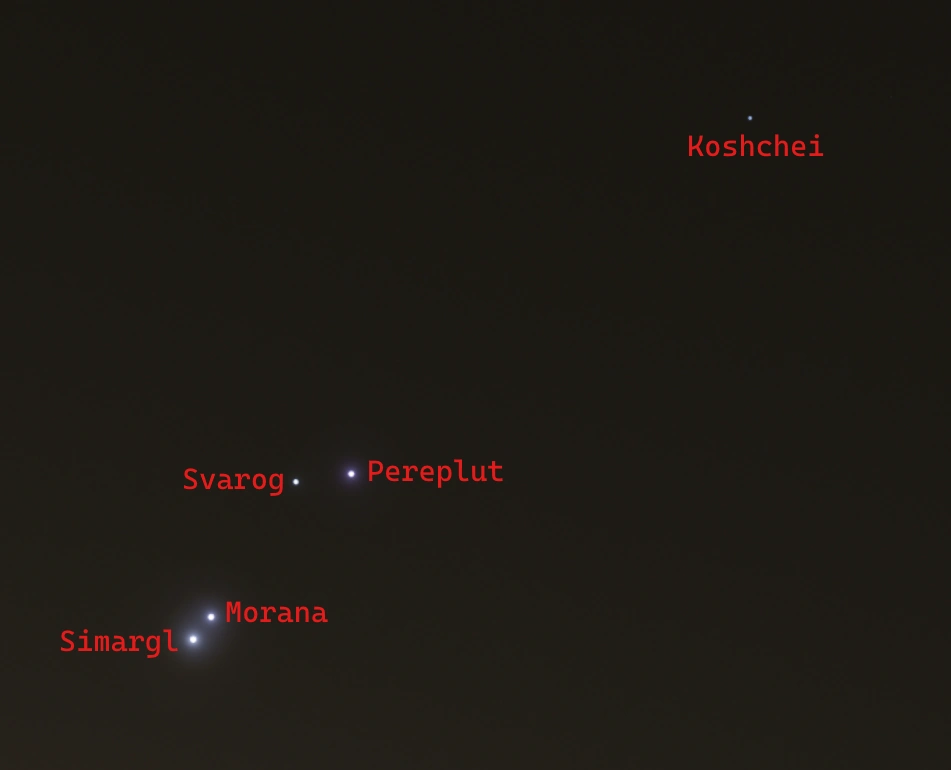

Planet parade on Viy with stars turned off.