General
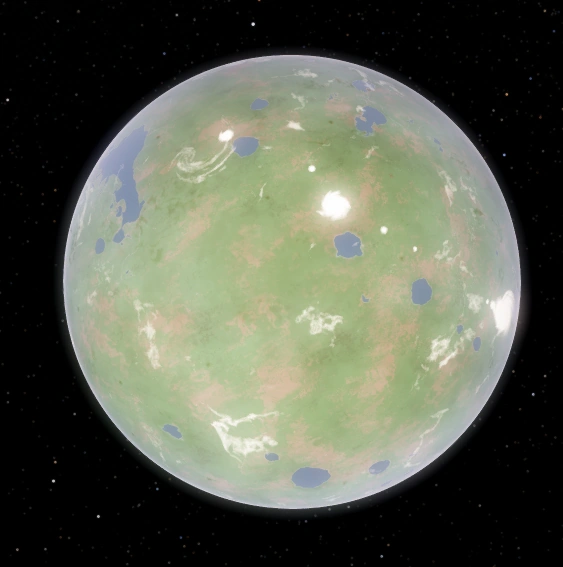
Bilora is a Selena orbiting a binary star system consisting of a White Main Sequence Star and Yellow Dwarf. It is located in the galaxy Fornax dSph. It is the farthest planet in the star system, and thus, is also the coldest.
The main features of Bilora consist of the large equatorial belt and the ice caps found on the poles. Dotted around this planet are also large cratered and mountainous areas called pox regions. These pox regions are filled with inactive or extinct volcanoes. They are found all over the planet, but are more common around the equatorial belt.
History
Formation
Approximately 1.8 billion years ago, the asteroid region around Biloras orbit condensed enough to form Bilora itself. During this time, it was relatively warm, but after a few million years, the asteroid bombardment stopped and the planet became significantly colder. The leftovers from the collisions formed the various rings around the planet, along with 6 of the moons orbitting around it (the other 9 moons were caught by the planets gravity).
The Volcanic Era
For a while, the planets crust shifted and twisted, causing massive volcanoes to dot the land. These volcanoes spewed ash and debris onto the surface, and helped with making the atmosphere denser. In fact, its entirely likely without these volcanoes, the planet would never have had any atmosphere at all. This period lasted for an incredibly long time, and during it, Bilora might've somewhat resembled a brown/white version of Io, due to just how many volcanoes dotted its surface.
Afer a couple hundred million years, the planets volcanoes slowly cooled and went into dormancy. Some even completely froze off and went extinct. The planet simply laid dormant for hundreds of millions of years after that.
Possible Reignition Era
It has been discovered that the planet has not completely frozen over just yet. In fact, its core and mantle are still quite hot, and in the past 100.000 years, it has slowly been reawakening. Various old volcanoes now have lava flowing through them again, and there are even new volcanoes popping up. This means that the planet is going through a second volcanic era currently. How long it will last is uncertain, but its possible it could last up to 200 million years.
Gallery


