Overview
Miranda is the innermost and smallest of Uranus's five main moons. Miranda's surface is covered with craters, valleys, and canyons, making it very unique and diverse. In addition, it is home to some unusual geological formations, including the five-kilometer-tall Verona Rupes cliff, which features a height of 20 km (12 mi).[1] The moon is named after Miranda, after the character in Shakespeare's The Tempest.[2] Miranda orbits close to the equatorial plane of its planet, sharing Uranus' intense seasonal cycle since Uranus orbits the Sun on its side.
Miranda is 470 km (292 mi) in diameter, and it's one of the Solar System's smallest studied objects that could be in hydrostatic equilibrium. Miranda's only close-up photographs are from the Voyager 2 probe, which observed Miranda during the Uranus flyby in January 1986. Miranda's southern hemisphere was pointing towards the sun during the flyby; consequently, only that area was studied. The composition of Miranda is composed primarily of rock and organic compounds, with water ice making up the remaining 60%.[3] It is composed of an ice-rock mixture core enclosed by an ice mantle, indicating that it is differentiated. It is also the least dense major moon in the Uranian system, with a density of 1.20 g/cm3.
Discovery
Miranda was discovered by Dutch-American astronomer Gerard Kuiper on February 16, 1948, by utilizing an Otto Struve Telescope, which is an 82-inch telescope at the McDonald Observatory.[2][4] Although its circular motion around Uranus weren't validated until 14 days after its discovery, on 1 March 1948.[2] The discover given the newly discovered moon a name "Miranda" after William Shakespeare's play The Tempest as the other previously discovered major moons of Uranus; Ariel, Umbriel, Titania and Oberon were named for the characters in Shakespeare or Alexander Pope.[2] Although its the only major moon of Uranus named after a human, in contrast from the precursory discovered major moons named after fairies.[5]
Orbit and Rotation
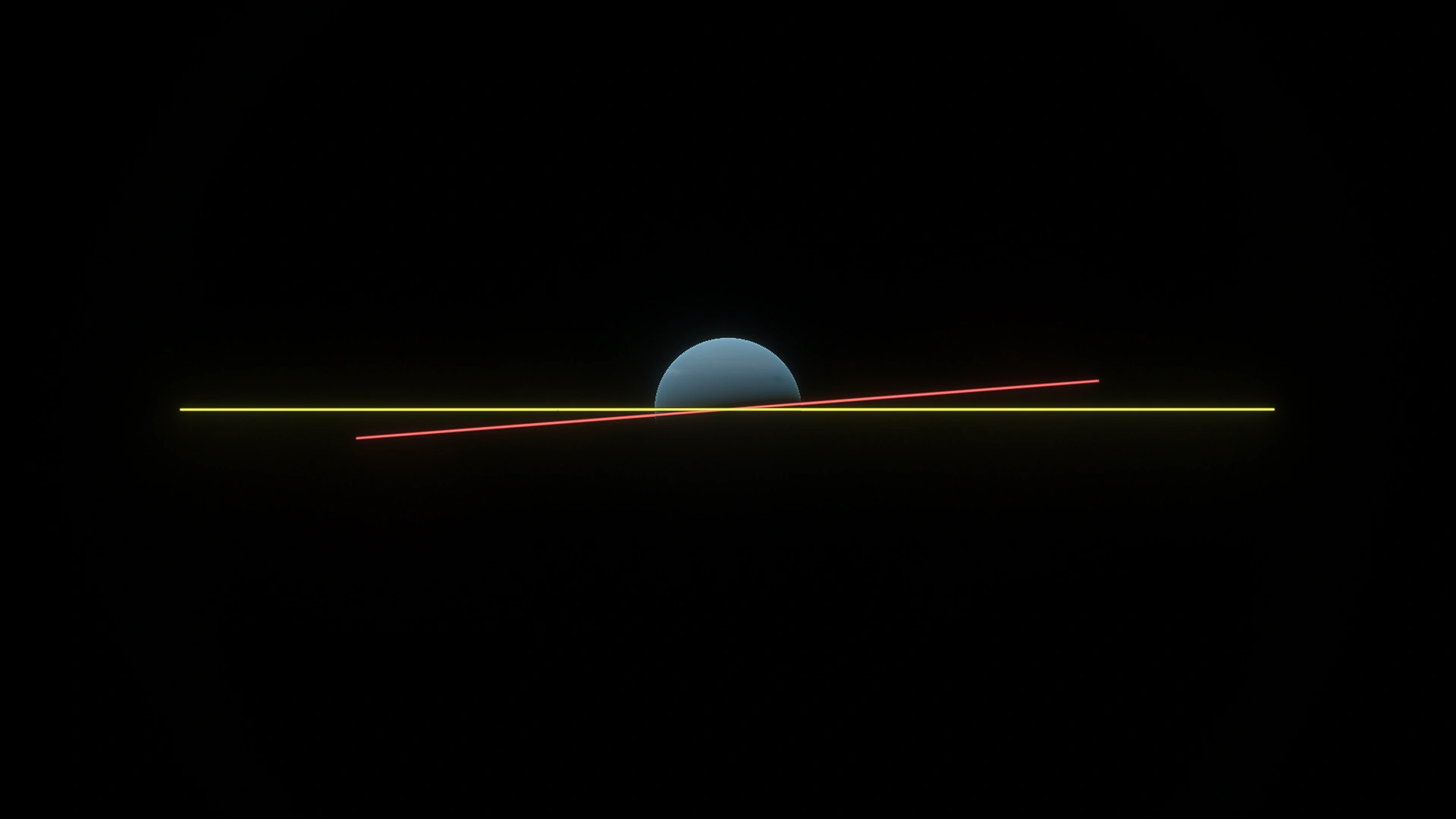

Miranda's inclined orbit highlighted in red, in contrast to Ariel's orbit in yellow.
Miranda's orbit is somewhat inclined, contrary to the rest of the other four primary Uranian satellites, with an orbital inclination of 4.13°. The reason for this is unknown; there aren't any mean-motion resonances among the moons that could clarify it, leading to the hypothesis that the moons occasionally undergo secondary resonances, which at some point in the past locked Miranda into a 3:1 resonance with Umbriel before chaotic behavior caused by the secondary resonances moved it out of it.[6] The moon also had a 5:3 orbital resonance with Ariel in the past.[7] Mean motion resonances are more easily escaped by the moons of Uranus due to the moons' larger respective sizes and Uranus's truncated oblateness.[8][9]
Miranda orbits the nearest of the four Uranian major moons, and it has a 34-hour orbital period that coincides with its rotational period, which means it constantly faces Uranus, a phenomenon called tidal locking. Since Uranus orbits the Sun on its side, Miranda shares the intense seasonal cycle of Uranus by orbiting adjacent to the equatorial plane of its planet.
Surface features
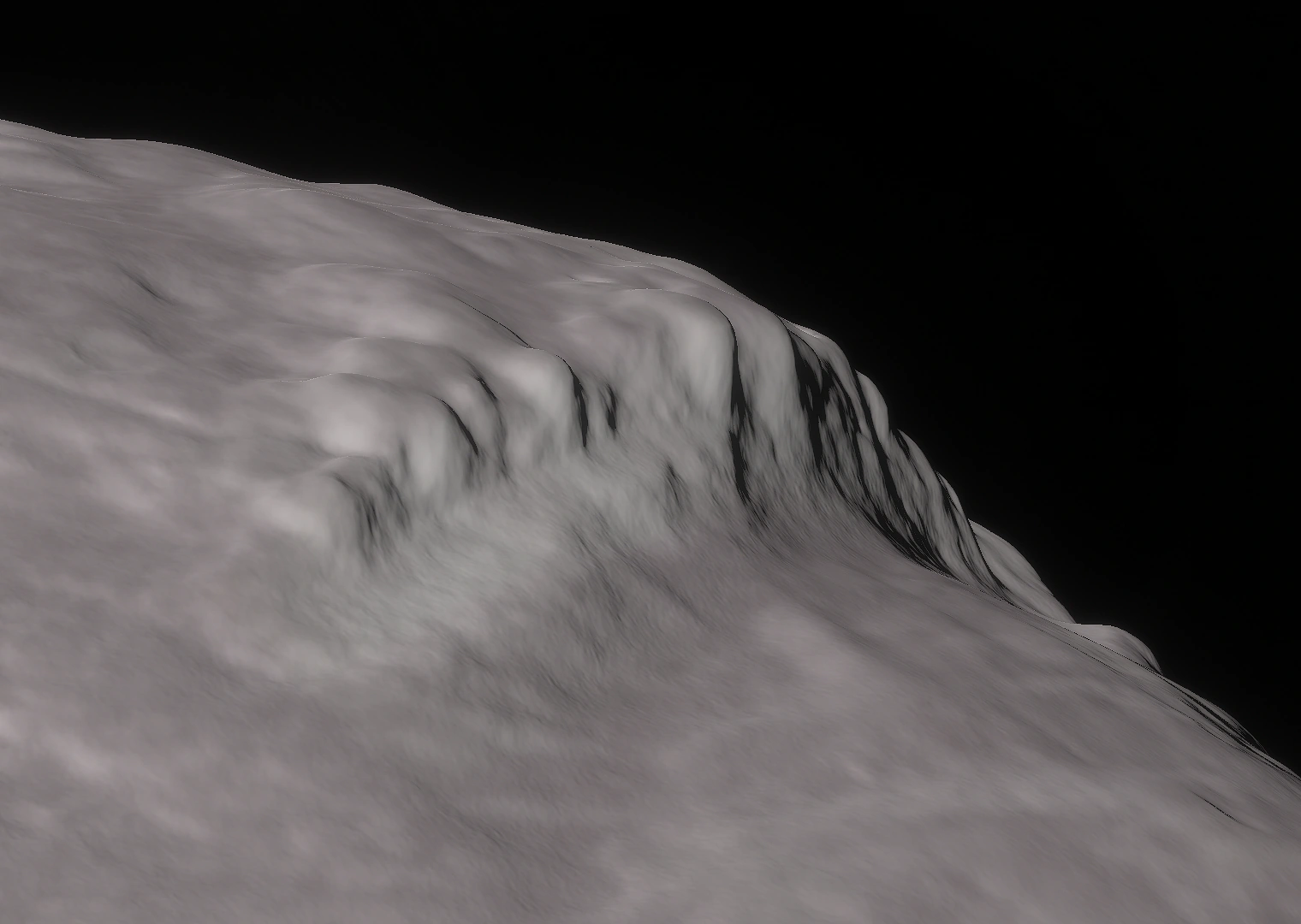

Verona Rupes, the tallest known cliff in the solar system.
Miranda's surface is characterized by patchy sections of fractured topography, indicating strong geological activity. Canyons crisscross it, which are thought to be the product of extensional tectonics. Miranda also boasts the Solar System's largest known cliff, Verona Rupes. The cliff was formerly believed to have a height of 5 to 10 km (3 to 6 mi), [10] but it was re-estimated to have a height of 20 km (12 mi).[1] It would take 12 minutes to fall from the top, colliding with the ground at about 200 km/s.[1] The enormous cliff might've originated from tectonic rifting and fractures or a large major collision.[1] Miranda's terrain is less than 100 million years old in some places,[11][12] whereas bigger areas contain crater counts that suggest ancient terrain. Since most of those craters aren't very big, it's likely that the majority occurred following a major resurfacing event in the distant past. Miranda's craters also seem to have softer edges, which could be caused by cryovolcanism or ejecta.
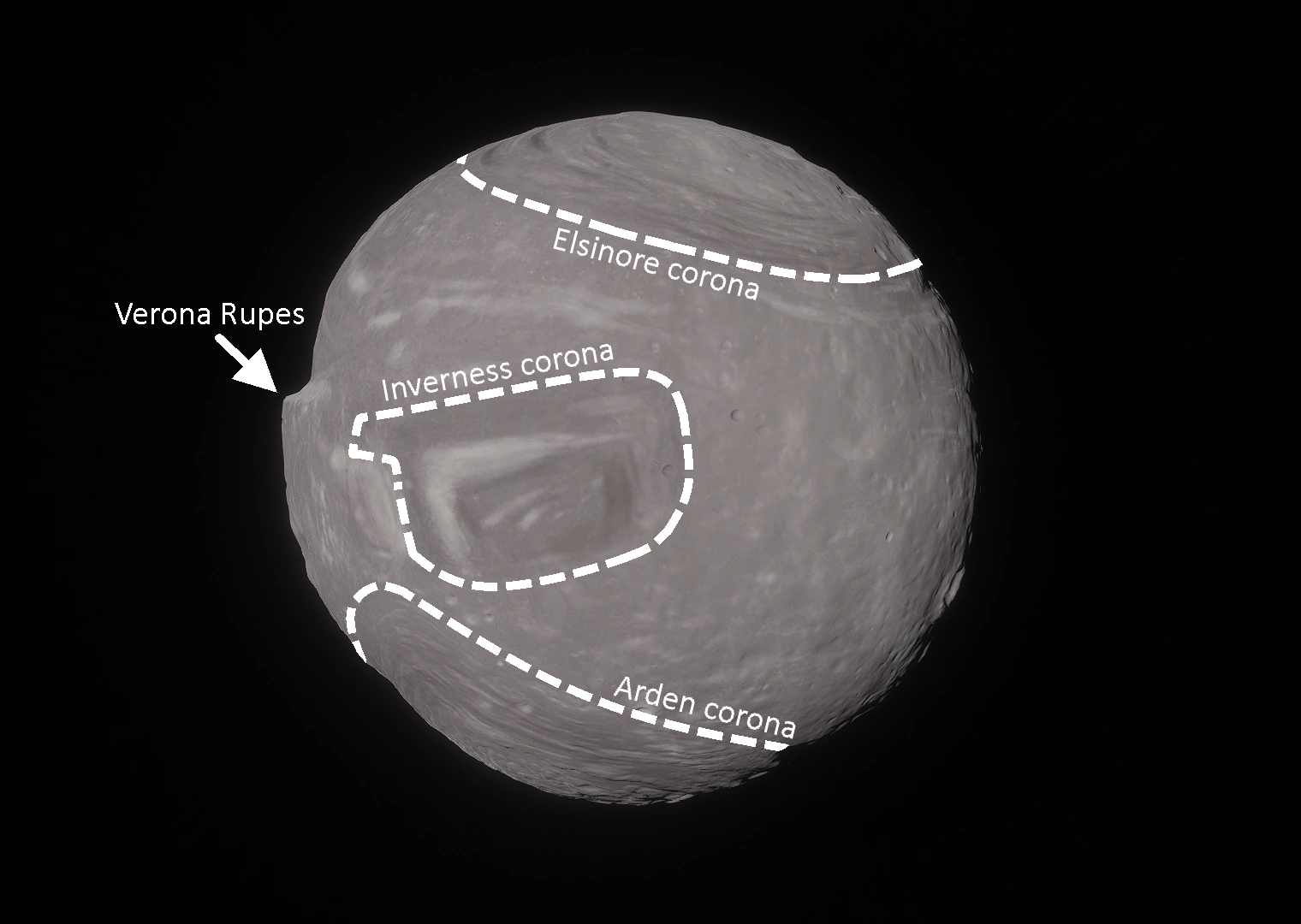

Visual of Miranda's prominent surface features
Miranda's observable hemisphere has three massive 'racetrack'-like grooved features known as coronae, they are one of its most recognizable traits on Miranda. Coronae are high ridges that encompass circular depressions. They are speculated to originate as a result of hot ice material rising from the mantle.[11][13][14] Miranda also has several unusual traits, such as its chaotic topography and grooved plains. Arden, Elsinore, and Inverness are names given to the three coronae. Their surfaces are rather sparsely cratered, which suggests that they cover the previously cratered terrain.
Origin
Miranda is known for its unique geological features. Scientists and astronomers have proposed various explanations for its unusual surface. One possibility is a past collision that left Miranda in pieces.[13] It is possible that these pieces erratically came back together to form the complex terrain.[13] Certain scientists propose the possibility of the moon re-accreting after several rounds of collisions, although the hypothesis was depreciated as it seems unfeasible. Another is tidal heating during a 3:1 orbital resonance with Umbriel,[7] which increased Miranda's orbital eccentricity up to 0.05-0.1 and generating tidal friction that warmed Miranda's interior by 20 K, triggering melting.[15][8][7] This period could have lasted up to 100 million years.[15] Although it did not produce much tidal heating, Miranda likewise had a 5:3 resonance with Ariel, its neighboring moon.[7] Another hypothesis suggests that Miranda may have originated from a disc of material surrounding Uranus, with an ice covering and rocky core. The interior structure of Miranda is distinctive, with a distinctive ice covering and rocky core. Rock and organic molecules may have settled due to internal differentiation caused by heat from radioactive decay, leading to their unique surface.
Exploration
Prior to Voyager 2's flyby of the Uranian system, Miranda was believed to resemble the Saturnian moon Mimas. However, Voyager 2's photos of Miranda's surface show that Miranda has a unique and complicated topography. Of all the Uranian moons including Uranus itself, Miranda had the closest approach to Voyager 2 at 29,000 km (18,000 mi),[16] bearing the most high-resolution map of any Uranian natural satellites. The only available current information about Miranda is based only on Voyager 2's flyby of Uranus, although several specific exploration trips to Uranus have been suggested, none have been given approval as of today.[17] Although Uranus was chosen more likely than Neptune because of its more favorable planetary alignments, which have an impact on travel times.[17] Only the southern hemisphere of Miranda was imaged by the Voyager 2 spacecraft, what lies on the northern hemisphere is currently unknown but there might be another additional coronae on the unmapped side according to computer modelling.[13]
Gallery


- ↑ 1.0 1.1 1.2 1.3 https://apod.nasa.gov/apod/ap161127.html
- ↑ 2.0 2.1 2.2 2.3 https://adsabs.harvard.edu//full/seri/PASP./0061//0000129.000.html
- ↑ https://zenodo.org/records/1230972
- ↑ https://mcdonaldobservatory.org/research/telescopes/struve
- ↑ https://ui.adsabs.harvard.edu/abs/1946PA.....54..122B/abstract
- ↑ https://ui.adsabs.harvard.edu/abs/1994CeMDA..59..129M/abstract
- ↑ 7.0 7.1 7.2 7.3 https://ui.adsabs.harvard.edu/abs/1990Icar...85..394T
- ↑ 8.0 8.1 https://ui.adsabs.harvard.edu/abs/1989Icar...78...63T/abstract
- ↑ https://ui.adsabs.harvard.edu/abs/1990Icar...85..444M/abstract
- ↑ https://ui.adsabs.harvard.edu/abs/1988Icar...73..427T
- ↑ 11.0 11.1 https://www.lpi.usra.edu/meetings/lpsc2007/pdf/1901.pdf
- ↑ https://www.sciencedirect.com/science/article/abs/pii/0019103590901667
- ↑ 13.0 13.1 13.2 13.3 https://www.space.com/27334-uranus-frankenstein-moon-miranda.html
- ↑ https://web.archive.org/web/20141015074202/http://m.teachastronomy.com/astropedia/article/Uranus-Miranda
- ↑ 15.0 15.1 https://ui.adsabs.harvard.edu/abs/1991uran.book..561C/abstract
- ↑ https://ui.adsabs.harvard.edu/abs/1987JGR....9214873S
- ↑ 17.0 17.1 https://www.planetary.org/articles/20170621-revisiting-ice-giants