Veles is the sixth planet of the Hypnos system, between Viy and Svarog. It is the 8th hottest, so second coolest planet, at 305 *C. Its 8194 km in diameter and 0.17 earth masses, larger and more massive than Mars, but smaller than Simargl's satellite Rarog.
Veles is the first object of the Hypnos' outer system - its the first object that is classified as hot, not torrid.
Veles is named after the slavic god of, other than other things, livestock. That is for despite a quite 2 small size and mass having 9 moons, 7 being in hydrostatic equillibrium. Its ESI is 0.48, the second highest value in the system, behind Vodyanoy.
Its semi-major axis is ~80 au, right now its located roughly 81 au from Hypnos. Veles begins the region of the system where Hypnos's influence is much less, therefore the bodies located here have much larger orbital periods - 69 years for Veles.
In our system Veles would be in the Scattered disc.
Veles's atmosphere is made of the "best" things imaginable: сarbon dioxide, sulfur dioxide, hydrogen sulfide, propane. Veles has black clouds, first caused questions but its actually fine with its atmosphere composition.
Veles is most simmilar to Morana, both are simmilar to Venus.
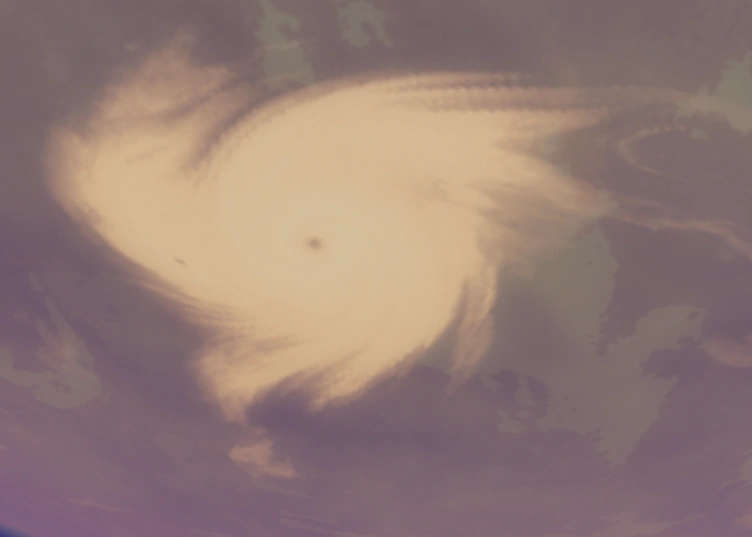
The Great White Spot

The Great White Spot
The Great White Spot is a huge hurricane on Veles, seen several times, but only recognized for what it is on September 7, 2025.
Great White Spot is located somewhere near Veles's equator. It is roughly 300 km in diameter, comparable to Mimas at 400.
It is also named "Veles's Eye", in russian "Oko Velesa".
The Great White Spot was lost and as of October 4, 2025 cant be found. A good scenario is that its on Veles's night side, and a sad one is that it vanished.
Physical characteristics
Veles is the third smallest and least massive planet in the system. Flying Triton model suggests Veles was the last planet to form, later than even Rarog, and it had very little material left. By the time of Veles' formation, the protoplanetary disc already lost most of its heavy elements.
Veles is 8194 km in diameter and 0.17 Earth masses. Rarog beats it in both (8398 / 0.19), both are like 1.5x the size of Mars. The density of Veles is only 3.59 g/cm3, this means its a rubble pile or made of a mix of rock and a significant amount of ices, the ices got baked out but not completely lost.
Veles is only the first planet of the Outer system but its already signifcantly cooler at "only" 303 *C, enough to melt lead, but compare this to the inner system. This lets Veles maintain a complex Venus-like atmosphere that is not being blown off. Its ESI reaches 0.48, a value never seen in the Inner system. Its bond albedo is 0.25 and geometric albedo is 0.3.
A day on Veles is very close to a day on Earth - 23 hours 39 minutes and 14 seconds. This likely means Veles' spin was not drastically changed by any impacts, like Morana's.
Its axis inclination is 9.33*
Its gravity on poles is 0.42g and on equator is 0.41g. While weak, it was enough to form its two tiny inner moons and capture some other moons. You need a speed of 4.1 km/s to orbit Veles and 5.8 km/s to escape it.
Orbit
Veles orbits Hypnos at an elliptic orbit with an eccentrcity of <0.02. It needs 68.42 years to complete one rotation, its semi-major axis is 79.95 AU, perihelion is 78.42 AU. Its presently 81.47 AU away from the star, closer to its unknown aphelion, probably ~82-83 AU. Veles' orbit inclination is -2*.
Atmosphere
Veles has an atmosphere that is 56.6% carbon dioxide, 38.5% sulfur dioxide, 3.83% hydrogen sulfide, 1.09% propane. This gives it a molar mass of 51.3. But with the pressure of just 0.0505 atmospheres, its not crushing that of Morana or Venus.
Its scale height is ~22-23 km, quite large for a normal terrestrial planet which Veles other than its temperature is. The air is 300 *C. The atmosphere barely heats Veles up, only by hundreths of a degree.
In the exosphere Veles' atmosphere reaches over 2000 *C in temperature. However this is not enough for its atmosphere to escape in massive amounts, like it happens in Rarog, Morana, Nav, Simargl, etc.. Its exosphere is also quite tiny compared to the inner planets.
Satellites
Its two closest satellites - Dazhbog and Yarilo, likely formed from a tiny circumplanetary disc around Veles and survived the huge migration 1.5 million years ago, and now can calmly orbit it for the 268 000 years they have left before the pair unstable supernova that vaporizes the system. Cute, amirite?
Zimun, Leshy and Belee, more outer satellites, are a huge mix of all trash Veles captured during its migration from all corners of the system.
But the outer Volos, Lada, Tur and Znich are the most interesting guys here. They are koviztoids like Koshchei and Viy, formed from a huge planet called Kovizt that was destroyed during the huge migration in the system.
Dazhbog
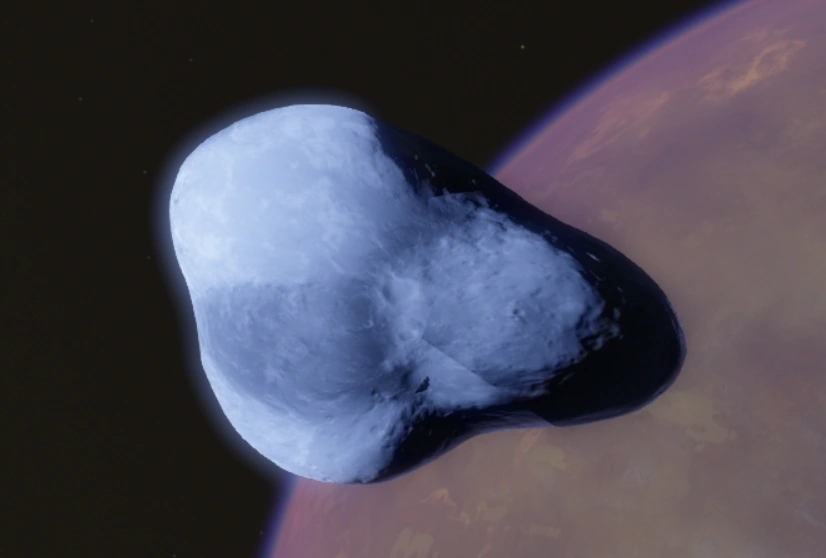

Dazhbog is the closest satellite to Veles, the smallest at 51.5 km in diameter, and the least massive. Its semi major axis is only 7488 km, that is comparable even slightly farther than Viy's Baba Yaga, but Viy is also much smaller than Veles, so Dazhbog can be called closer.
It is very bright, when first seen on August 30 it was initially mistaken for a feature on Veles' surface, so it is also nicknamed The Blue Spot. It was only recognized for what it is on September 7.
Dazhbog looks like a koviztoid but is not thought to be one.
Yarilo

SHV2
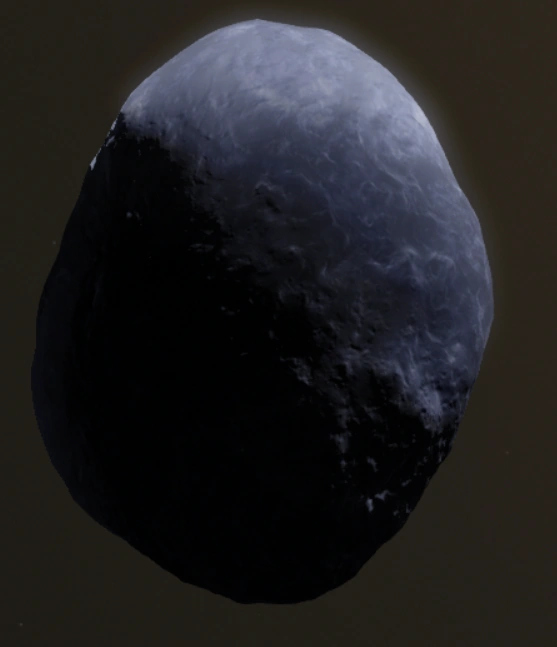
Yarilo is the second closest satellite of Veles, the second and last dwarf satellite.
Its named after the god of sun at spring, for being warmer than all other satellites - 314 *C instead of ~294 *C.
Its semi-major axis is only 14 325 km.
Yarilo's diameter is 92 km.
Yarilo has a crater shaped like a heart.
Its ESI is 0.077 which is the smallest among Veles' satellites.
Zimun
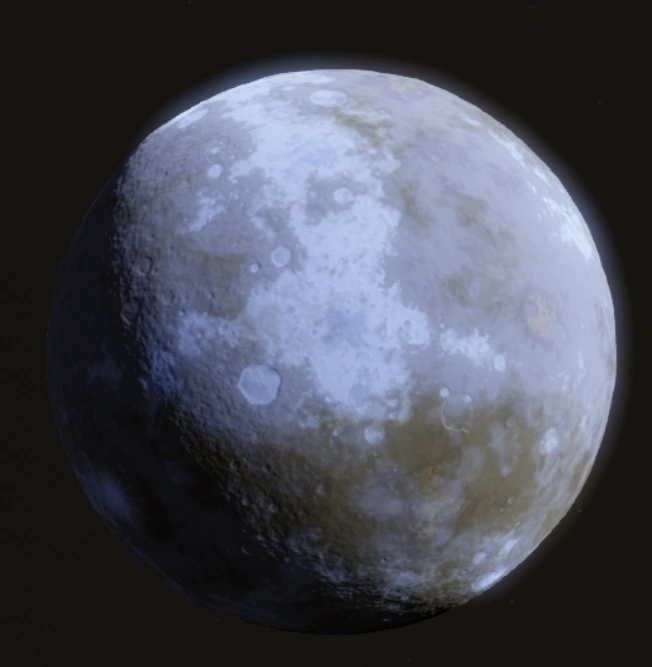

Zimun is the third closest satellite to Veles. It has a diameter of 1631 km and a mass of 0.0012 earths, an ESI of 0.312. This makes it the least massive and has the smallest ESI out of the Veles satellites in hydrostatic equillibrium
Leshy
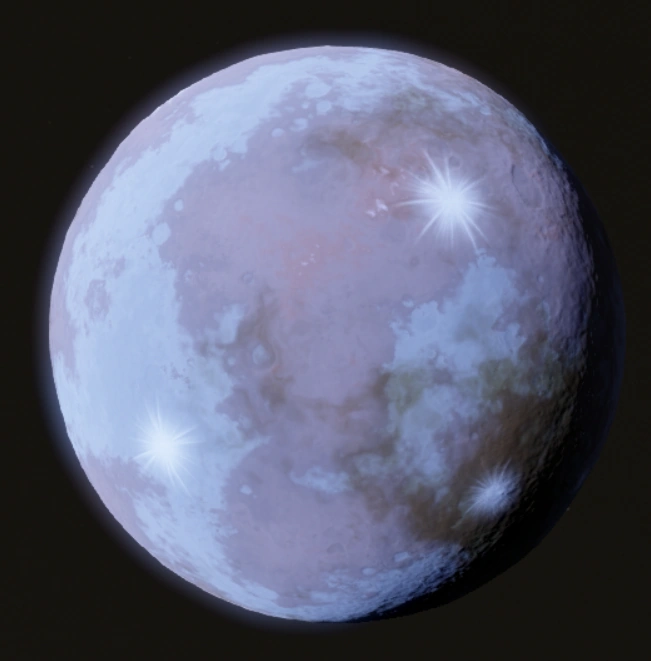

Leshy is the fourth closest satellite to Veles, it has a mass of 0.0014 earth masses and a diameter of 1505 km. Its ESI is 0.335
Named after the spirit of forest in slavic mythology for no reason, seriously, it has nothing related to forests.
It has a weird huge purple region.
Belee
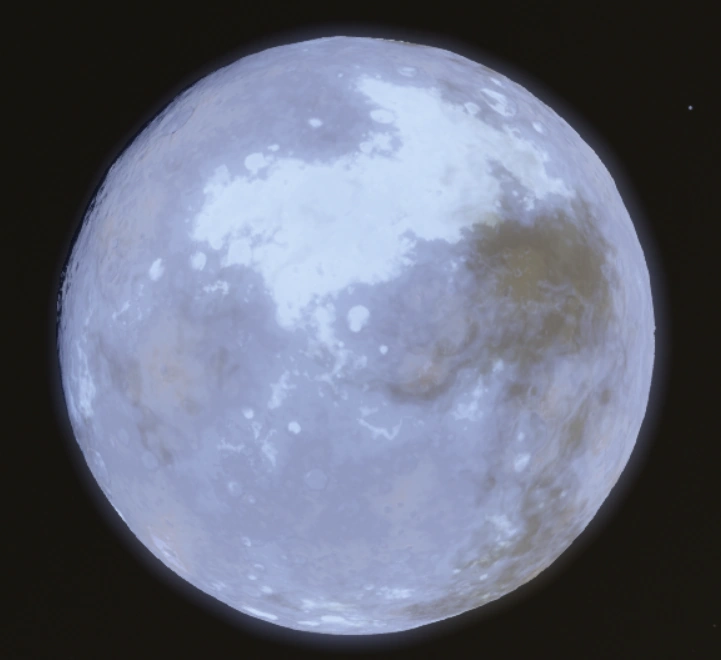

Belee is 1407 km in diameter and 0.0016 earth masses.
Its named after the patron of livestock from diseases.
Its ESI is 0.335.
Volos
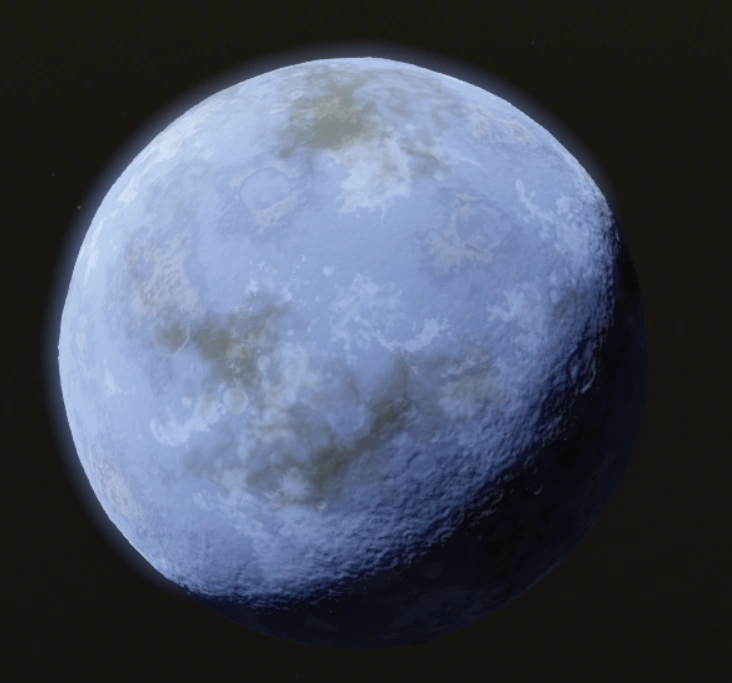

Volos is the third largest and sixth fartest from Veles, a koviztoid. Its 1660 km in diameter and has 0.0018 earth masses. Its semi-major axis is 113 802 km.
It has an ESI of 0.344
It has dark spots resembling a smiling face if you have enough fantasty, just like Pereplut's satellite Lel.
Volos is just another name for Veles, but Volos is usually associated specifically with livestock.
Lada
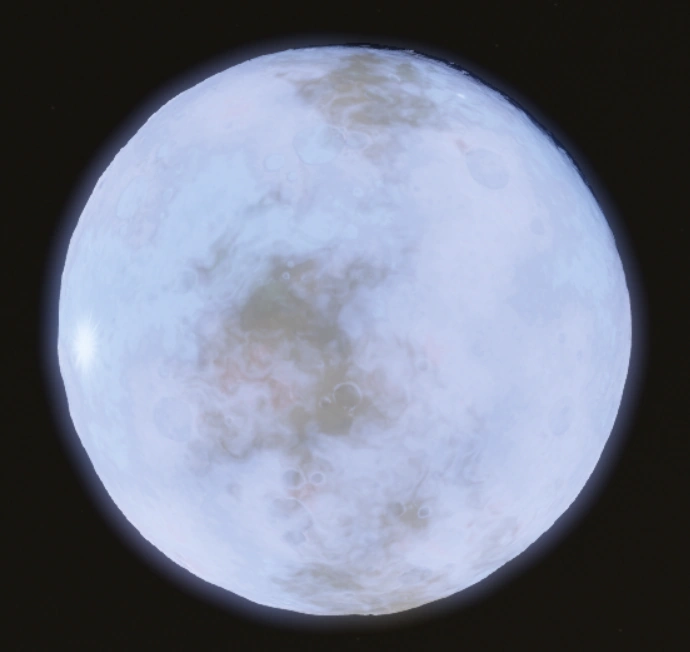

Lada is the third farthest satellite and a koviztoid. It is 1555 km in diameter and has 0.0023 earth masses.
Its ESI is 0.345.
It has dark spots resembling a face if you have enough fantasy.
Lada is a controversial god but usually associated with fertility.
Tur
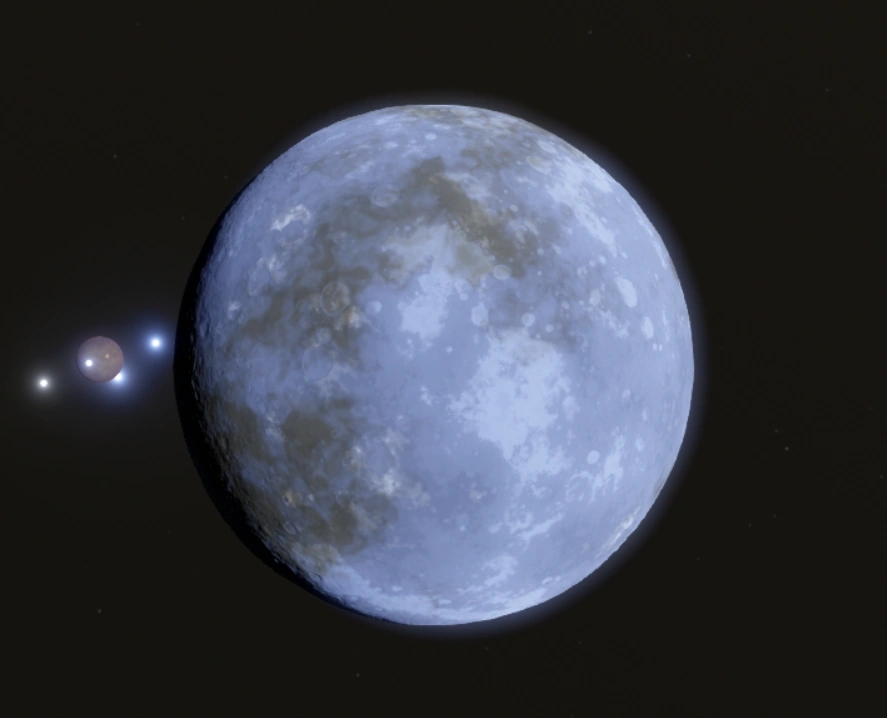

better image of Tur, 9 September 2025
Tur is the largest satellite of Veles and a koviztoid. Discovered on September 7, 2025. It is sixth by distance from it. Its 2092 km in diameter and 0.002 earth masses.
Its ESI is a high value for the system - 0.336, its orbital period is simmilar to that of moon - 29 days
Its semi-major axis around Veles is 223 000 km.
Tur was first visited two days earlier than the rest of Veles system, on September 7th 2025.
Znich
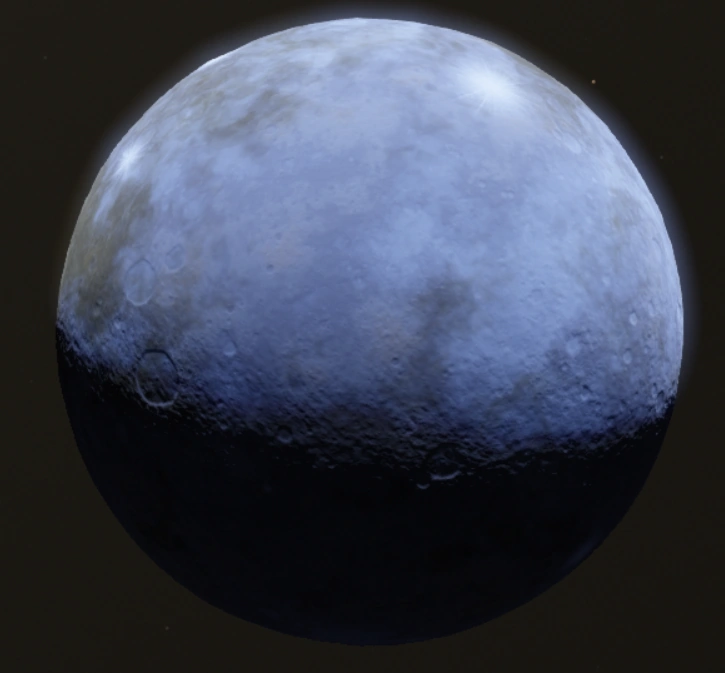

Znich
Znich is the farthest satellite from Veles, a koviztoid. Discovered and described on September 9, 2025. It is 1938 km in diameter, with is just 1.07x smaller than Tur, but Tur still got more attention, while Znich got as much attention as the rest of the Veles system. Znich is also 0.003 Earth masses and Esi is 0.36, which is even more massive than Tur.
Its semi-major axis is 314 000 km, which is still closer than Moon to Earth, but Veles is also smaller than Earth, sooo.
Gallery

