The central role of hydrocarbonsTitans are cold planets mainly composed of rocky material, water ice and organic compounds. Despite the significant difference in temperature they share several features with terran planets. This is primarily due to the presence of large amounts of hydrocarbons on these planets. Since temperatures below 180 °C are no exception hydrocarbons can be found in solid, liquid and gaseous state. On the surface of these planets compounds such as ethane, methane and propane take the place that water occupies on terran planets in the hydrological cycle of precipitation and evaporation[1]. It is not rare to find oceans of methane spanning many millions of square kilometers. 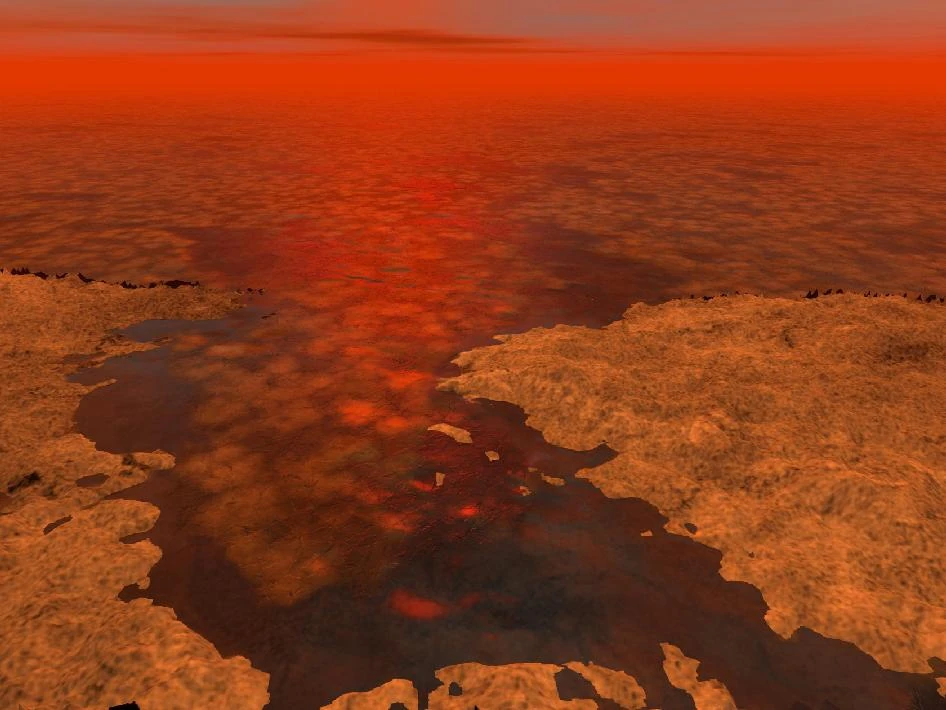 Artist's rendition of a hydrocarbon ocean Atmospheric and geologic propertiesA majority of titan worlds also possess substantial atmospheres that consist of nitrogen, ammonia, methane and traces of carbon dioxide, carbon monoxide, noble gases and complex organic compounds. The presence of hydrocarbons in the atmosphere is the consequence of cryovolcanic eruptions, another phenomenon frequently observed on titan worlds. Instead of scorching hot magma, cryovolcanoes eject cold slurries of water-ice and ammonia. In general the surface of titans is geologically active and the presence of atmosphere combined with the aforementioned properties of hydrocarbons leads to the emergence of seasonal weather patterns and erosive processes that are responsible for the formation of dunes, mountains and canyons. Exotic lifeThe combination of complex organic molecules under these circumstances can lead to the formation of life-forms. These organisms are usually called "exotic" life, as their intracellular liquid is mainly composed of methane, which gives them fundamentally different biological properties in comparison to water-based organisms that are usually found on terrae[2]. The cells of exotic biota are several times bigger than their terran counterparts and their metabolism is slow, which also increases their life-spans. The breathing process usually involves high-enery acetylene contained in the atmosphere and hydrogen.  Artistic conception of a bioluminescent organism living inside a methane ocean. image by davesrightmind Natural resourcesTitan worlds colonized by sentient species are often exploited for their vast amount of natural resources.[3] Especially when a civilization has not yet developed advanced nuclear propulsion technologies the organic chemicals found on titans are a valuable asset. |
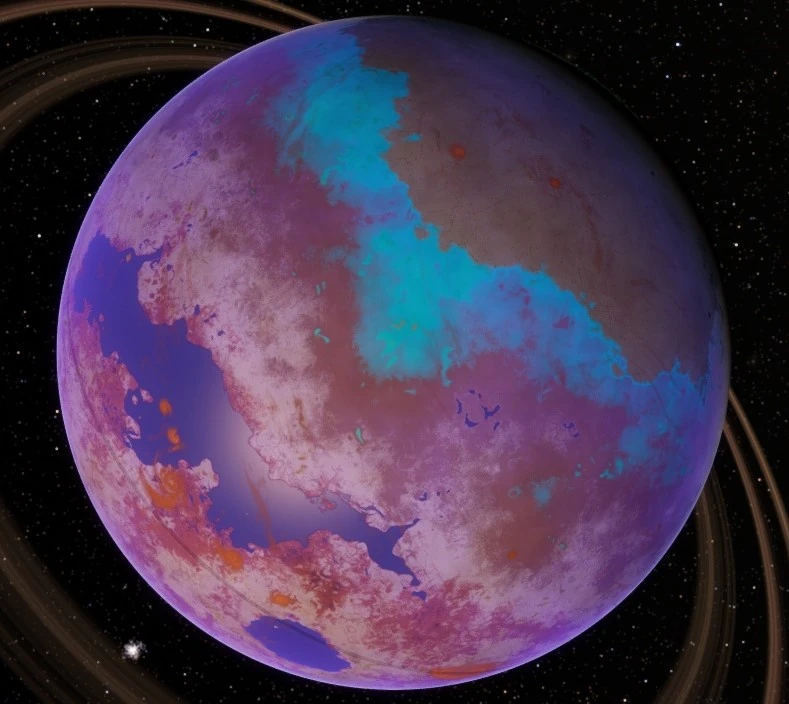 View of Krinomak, a massive titan with relatively thin atmosphere.
|


