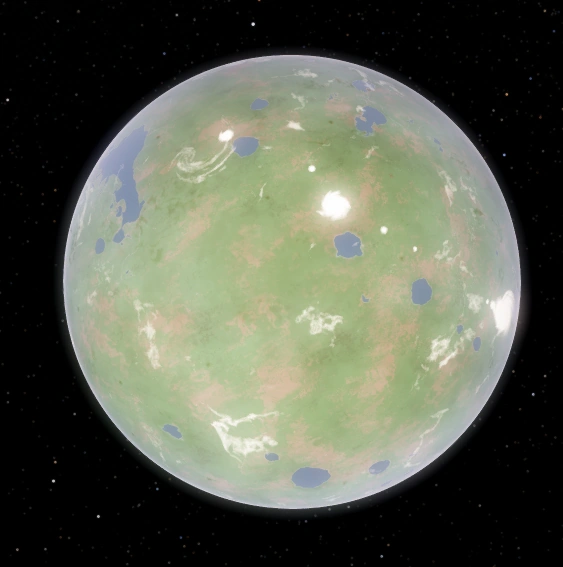
(I sort of wrote the "lore" section at different times, so expect it to be all over the place. And despite the very low atmospheric pressure, there is somehow a weather system here.)
Twimenla's information
Technical details
This is a cold megatitan that has a diameter of 17734.04 miles, a mass of 13.404 M⨁, or 8.008*10^25 kilograms, and a density of 6.6958 grams per cubic centimeter. The oblateness of titan is 0.017452, with the effective temperature being 119.25 kelvin, (-245.02 degrees Fahrenheit, or -153.9 degrees Celsius), and the Earth similarity index is 0.469, in addition to that the albedo (bond, geom), is 0.58 and 0.695999. The rotational period of the planet is 9 hours, 37 minutes, and 19.19 seconds, with the solar day being 9 hours, 38 minutes, and 41.75 seconds, and the axial tilt is 27*48’21.40”. The age of the planet is very young, only 760.889 million years, with the gravity on the poles / equator being 27.211 meters per second and 25.8 meters per second, and the circular velocity / escape velocity is 12.03 miles per second, and 17.01 miles per second. The height of the atmosphere is 16.35 miles, with the tropopause height being 3436.84 feet, and the height of the homogeneous atmosphere is 5194.71 feet.
The atmospheric pressure is 0.412 atm, with the air density being 1.0042 kilograms per cubic meter, and the air temperature is 125.97 kelvin, ( -147.18 degrees Celsius, or -232.924 degrees Fahrenheit). The speed of sound on this world is 772.62 feet per second, with the exosphere temperature being 806.74 kelvin, and the greenhouse effect is 6.2437 Kelvin. The average molar mass is 28.802, with the relative mass being 4.5988*10^-8 , and the real mass being 6.1644*10^-7 M⨁. Nitrogen makes up 95% of the atmosphere, with Carbon dioxide making up the rest. The orbital type of this planet is elliptical, with the parent star of this planet being the secondary of a star system, and the orbital period is 168.601 days The semimajor axis is 0.40 AU, with the pericentric distance being 0.38 AU. The eccentricity is 0.046, with the inclination being -2*14’22.11”, and the ascending node is 118*53’32.62”. The argument of pericenter is 265*00’44.74”, with the mean anomaly being 146*41’47.98”, and the longitude of pericenter is 383*54’17.37”, in addition to that the mean longitude is 530*36’05.35”. The hill sphere radius is 1256534.67 miles, with the influence sphere radius being 1046819.62 miles, and the Roche limit for satellites is 14004.03 miles.
Infolore
Located in a small un-bothering star cluster above the Ambrosia galaxy, this cold Megatitan is a true colossal giant. With a diameter more than twice that of Earth and a mass 13 times greater, it's an astounding celestial body. Only a few titans attain such immense size and mass. This massive world is marred by raging cyclones, ferocious nitrogen hurricanes that can attain Category 5 wind speeds. The largest among them managed to engulf a sixteenth of the day side, a size that might not sound extraordinary until you consider it in Earth's terms, where it would cover almost an eighth of our planet's surface. These cyclones form over the megatitan's mega ocean, a sea of hydrocarbons at bone-chilling temperatures, plunging into the hundreds of negatives. In addition to that, these cyclones could also spawn small tornadoes that can get to monstrous sizes, 4 - 5 miles in some cases, though they spawn most of the time on the ocean; and across this vast expanse of liquid hydrocarbons, 29 distinct, “expansive” land masses rise. These land masses are characterized by four predominant biomes: Ammonia hills, Hydrocarbon coast, Ammonia Bog, and Nitrogen plains.
What's striking is that these landmasses are exceptionally low-lying, with the majority of them submerged more than 10% below sea level. This peculiarity is noticeable from space as there is a trend (though not perfect) in color, the more purple/pink an area is, the more likely the area is below sea level/tide level, (though most of the hills and cliffs here have purple as a predominant color, it still tracks.) The exact reason behind this phenomenon remains a mystery. Delving deeper into the landscape, one discovers that it's surprisingly malleable, akin to hardened clay, yet soft enough that it can be molded with some effort; this also may mean that erosion here occurs at an accelerated rate due to how soft the land is. This clay-like terrain is punctuated by hundreds of smaller hydrocarbon lakes, ponds, and streams. This patchy landscape bears a striking resemblance to the northern to middle regions of Canada with its numerous lakes and ponds. This may be attributed to the accelerated erosion of this world, which can create all of these small indentations into the ground that are now home to small deposits of liquid hydrocarbons.
These indentations could also mark ancient impact craters from comet strikes during formation. Perhaps the most astonishing feature of this world is that between 2015 and 2017, a 30th landmass emerged from the ocean floor, connecting some of the scattered islands in the region where it appeared. During the period of our study, we were able to delve beneath the ocean floor and uncover a geological tapestry. It includes sedimentary rocks, sediment, igneous rock, frozen hydrocarbons, and various other types of rock, revealing the secrets buried beneath this enigmatic megatitan’s oceans. Looking up into the day sky, you will notice that there is a bright dot in the sky. This thing is another star that exists in the same system, and it is bright enough that it can illuminate the night side of this planet when it is in position, a beautiful site above Ammonia waters on a granular coast, you could also read by starlight here.(Just realized that on the day side (Not at direct noon) that you could see the other stars of the cluster that this world is part of, crazy.) There are not that many other things to say about this barren, peculiar megatitan.
Gallery


Map

Moons
The hulking megatitan has 7 moons, 2 major moons, and 5 minor moons. The planet’s first major moon is a barren cold Selena that most likely formed around the planet, it also exists close to its parent (this planet), unlike its brother, or adopted sibling most likely. This other major moon does not orbit on the plain of the megatitan, and instead orbits on a large tilt, and the reason for this is that it might be a captured planetoid from the formation of the star system, or it could be a fragment from formation like the cloud of minor moons it orbits in. This cloud is not really a cloud though is it now?, it is more like a group, it only has 4 minor moons which are from the planet’s early days of formation. There is one other minor moon and it orbits tightly to the megatitan, it is only ~31000 miles away from its parent planet, and orbits in 8 ½ hours around it. An odd fact about the first and partially the second major moon is that the parent planet has this soft red glow for some reason that gets shined on the first major moon and partially the second.
| Categories | Twimenlobos | Twimenerlas |
|---|---|---|
| Photograph |  |
 |
| Class | Cold selena | Cold ice world |
| Mass | 0.0015242 M⨁ | 0.0017747 M⨁ |
| Diameter | 1182.35 Miles | 1149.31 Miles |
| Orbital period | 22h 28m 6.14s | 8.110 days |
Star system
The planet is part of a 19 planet system that is a binary between a white main sequence star, which has 9 of the planets, and a red dwarf, which has the rest of the planets. There are separate oort clouds for each of the stars, and both stars do not have an asteroid belt.
Star system (A)


Star system (B)


