Overview
Neptune is the eighth and outermost planet in the Solar system. It belongs to the category of massive planets known as ice giants. The diameter of Neptune is approximately 49,248 km (30,601 mi), and its mass is approximately 17 times that of Earth. Its winds are more ferocious than Jupiter's, as they can reach speeds similar to or greater than supersonic speed. There are numerous episodes of anticyclonic dark storms, or "spots," appearing in Neptune's atmosphere over time; the most notable of them all is the Great Dark Spot, discovered when the Voyager 2 probe conducted a flyby of Neptune. Although multiple proposals have been made but not yet approved, there are currently no missions scheduled to visit Neptune. Neptune's great distance from the Sun hasn't influenced human culture for generations, as it is virtually invisible to the naked eye, unlike the seven classical planets of the Solar system. Neptune remained undiscovered until in the middle of the 19th century, as it's the first and only planet to have been predicted by utilizing mathematics as it was noticed that Uranus is getting gravitationally perturbed by an unknown object according to observations, who is later revealed to be Neptune. One of the pioneers who contributed to Neptune's discovery has given it a name after the Roman god of the sea, Neptune.[1]
Interior structure
Neptune is the outer of Sol's two ice giants - gaseous worlds composed primarily of volatile materials heavier than hydrogen and helium, such as methane, water, and ammonia, which are known in planetary science as 'ices'. It has no solid surface, instead having a steadily thickening atmosphere composed of hydrogen, helium and methane which gives way to a thick, liquid, ice-rich mantle as depth increases, ending eventually in a solid rocky core. The planet has some of the fastest winds in the Solar system, with top speeds of over 2100 km/h occurring in its dynamic and impressive storm systems.
Magnetic field
Similar to Uranus, Neptune has a magnetosphere that is displaced from its center by around 13,500 km (8,388 mi) and has a magnetic axial tilt of 47°, which is significantly tilted. It was thought that Uranus's sideways rotation was the cause of the tipped magnetosphere before Voyager 2 reached Neptune. But according to current scientific theory, the reason for the unusual orientation might be flows within the planets' innards, which are caused by convective fluid movements in a thin, spherical shell of electrically conducting liquids, most likely a mixture of water, ammonia, and methane[2] that produce a dynamo effect.[3]
Neptune's bow shock, in which the magnetosphere hinders the pace of the solar wind, occurs at 34.9 times the planet's radius. The magnetopause, where the magnetosphere's pressure balances the wind, is 23-26.5 times the planet's radius. The magnetosphere's tail is at least 72 times the planet's radius, but could be far bigger.[4]
Internal heating
Neptune's weather is more complex than Uranus' because of its increased internal heat. The top troposphere has a low temperature of 51.8 K (−221.3 °C), whereas at a depth of 1 bar (100 kPa), the temperature is 72.00 K (−201.15 °C).[5] Uranus' source of heating is unknown, but the difference is greater; Uranus only radiates 1.1 times as much energy as it receives from the Sun,[6] whereas Neptune radiates approximately 2.61 times as much energy as it receives from the Sun,[7] and despite being the farthest planet from the Sun and receiving only 40% of its sunlight,[8] it still has enough internal energy to drive the fastest planetary winds in the Solar system. Depending on the temperature characteristics of its interior, the heat left over from Neptune's development may be adequate to clarify its present heat flow, but it is more difficult to explain Uranus's lack of interior heat while maintaining the two planets' apparent similarities.[9]
Formation
The most commonly accepted explanation of the Solar system's ice giant origin is that they formed closer to the Sun, when matter density was higher, and then migrated to their present orbits after the gaseous protoplanetary disk went away.[10] The theory of migration after formation is favored as it clarifies the presence of the populations of small objects reported in the trans-Neptunian region.[11] The Nice model, which explores the influence of migrating Neptune and other massive planets on the formation of the Kuiper belt, has become the most widely accepted explanation for the features of this theory.
The gas giant's orbits gradually changed over time in the early Solar system as a consequence of encounters with planetesimals. Once Jupiter and Saturn reached a 2:1 orbital resonance (in which Saturn orbited the Sun once for every two Jupiter orbits) after 500–600 million years,[12] Uranus and Neptune's orbits were perturbed and their eccentricities increased. Neptune surge past Uranus and entered the thick primordial Kuiper belt as a result of encounters between the planets.[13] This in result caused the primordial Kuiper belt to dissipate, it is believed to be the cause about how Neptune gravitationally captured Triton and made some of the majority of the trans-Neptunian objects in orbital resonance with Neptune, like Pluto.
Atmosphere
Neptune's atmosphere consists mainly of hydrogen and helium. A small percentage (about 1.5%) of methane is also present and gives the planet its peculiar blue colour, by absorbing the red end of the spectrum of visible light.[14] Compared with Uranus, which has a similar amount of methane in its atmosphere, the blue colour of Neptune's atmosphere is much more vivid. This might be caused by an additional component which is currently unknown.[15] The distribution of gases in Neptune's atmosphere is not homogeneous, as in the equatorial region the amount of methane, ethane, and ethyne is ten to a hundred times higher.
Drawing the line between the "surface" and "atmosphere" of Neptune is not an easy task because there are no clearly definable boundaries. The definition of the limit between surface and atmosphere is therefore purely arbitrary: the atmosphere begins above the altitude where the pressure is equal to the pressure found at sea level on Earth.
The atmosphere is divided into four different layers:
- The lowest layer is called troposphere. In this region temperature decreases as altitude increases. This temperature gradient is caused by the heat emanating from the planet's core, which has a greater influence than the light coming from the distant Sun.
- Above the troposphere lies the stratosphere, where temperature increases with altitude because sunlight is now more influential than the planet's inner heat.
- The next layer is the thermosphere, which is characterized by lower pressures and temperatures of 750 K. These temperatures are so high that they can't be explained by sun's radiation alone. One possible explanation for this phenomenon could be the atmosphere’s interaction with ion’s in the planet’s magnetic field.[16][17]
- The outer layer is the exosphere, which is only slightly cooler than the thermosphere (about 600K) and is heated by the same anomalous process as the thermosphere.
Climate and storms
Neptune's atmosphere shows differential rotation, which is defined by changes in rotating speed between latitudes. This rotating pattern is clearly visible because the equatorial zone rotates at a slower rate, completing a full revolution in 18 hours, whilst the polar portions revolve at a much quicker rate, with a period of just 12 hours. The combination of these contrary velocities, along with the considerable temperature disparity between Neptune's core and the frigid expanse of space, results in severe storms and massive wind shears. The severity of these winds may reach speeds of up to 2100 km/h, surpassing even Jupiter's powerful storms. Notable among Neptune's highly turbulent weather occurrences is the enormous anticyclonic storm known as the "Great Dark Spot," which piqued astronomers' interest when it was discovered in 1989. Unfortunately, the duration of the storm was temporary, as later measurements through the Hubble Space Telescope revealed its slow evaporation. Following the dissipation of the "Great Dark Spot," a strikingly similar impermanent storm known as "Scooter" appeared in the planet's northern hemisphere, highlighting a trend indicating the relatively short duration of Neptune's atmospheric disturbances in comparison to Jupiter's long-lasting storms.
Motion
Neptune maintains an average distance to the Sun at around 30 AU, and completes its orbit every 164 Earth years or around 89,666 Neptunian days.[18] The planet is also the second-most circular orbit, at around 0.009, just behind Venus. Neptune's orbital inclination is 1.46° in relative to the ecliptic.
Neptune's orbit has been greatly influenced the Kuiper belt, a region where icy objects like Pluto orbits. Compared to the asteroid belt, this particular belt is much bigger, spanning from 30 AU, the location of Neptune's orbit, to around 55 AU from the Sun. Jupiter's gravity influences the asteroid belt similarly to how Neptune dominates the Kuiper belt and shapes its structure. Over the Solar system's lifetime, Neptune's gravity destabilized some areas of the Kuiper belt, causing structural voids. An example of this area is 40–42 AU.[19] There are orbits in the unpopulated regions of the Kuiper belt where things may last for the age of the Solar system. When Neptune's orbital period is a specific percentage of the object's, such 1:2 or 3:4, these resonances happen. With more than 200 confirmed objects,[20] the 2:3 orbital resonance is the most densely inhabited resonance in the Kuiper belt, and they are called Plutinos, named after the dwarf planet Pluto, which makes sure they do not collide by completing two orbits for every three around Neptune. There is less population in the other resonances, which include 3:4, 3:5, 4:7, and 2:5.[21]
Neptune has a moderate axial tilt of 28.32°, similar to Mars and Earth's axial tilt. Because of its long orbital period, the planet's seasons last for 40 years. When one pole of the planet is exposed to sunlight it warms up enough to allow methane to sublimate and leak into space. The Neptunian magnetic field is dramatically offset from the planet's center of mass and not aligned with its rotational axis.
Neptunian system
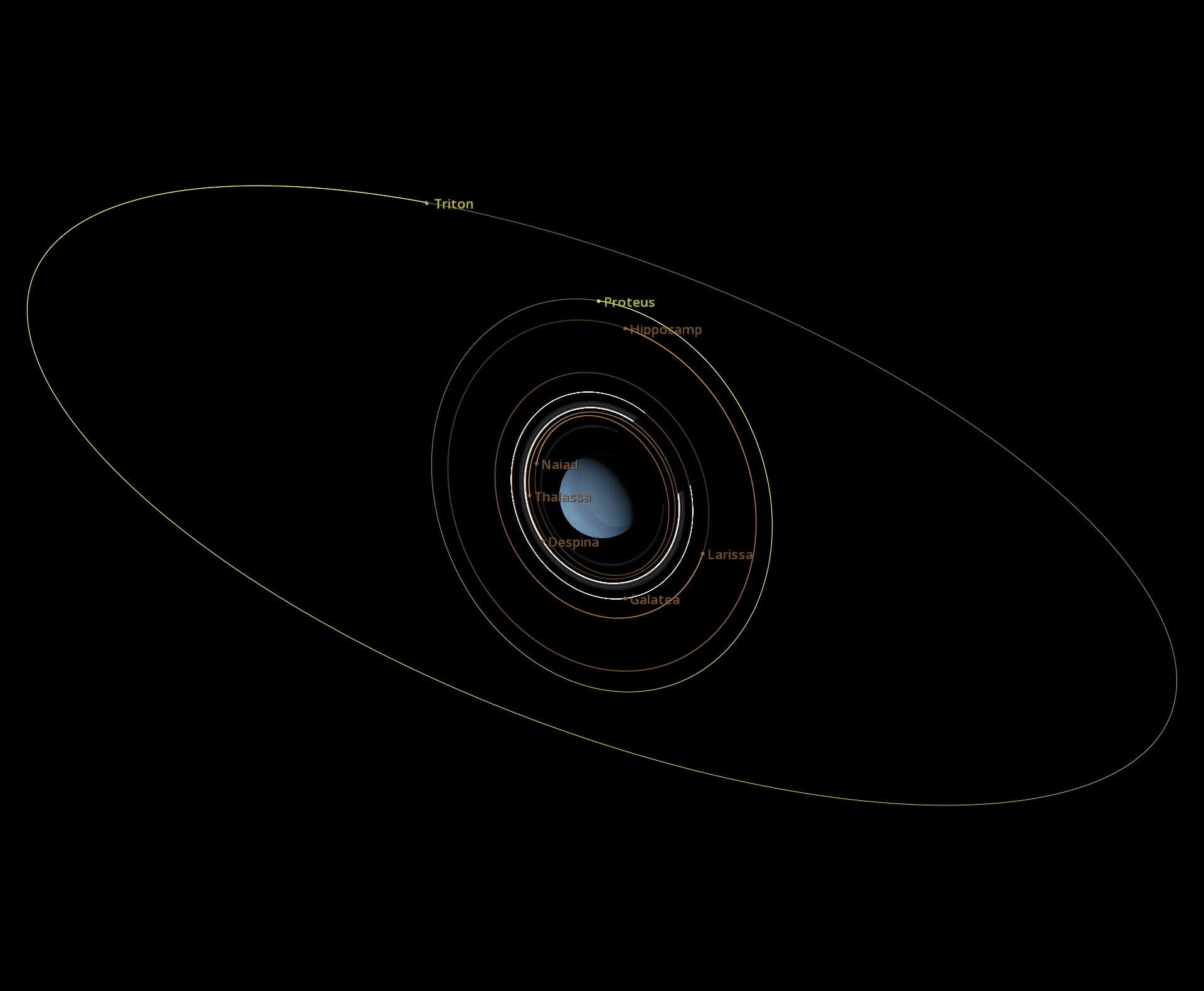
The Neptunian system diagram, excluding all of the irregular moons except Triton.
Neptune has a system of 16 known moons (technically 14 in-game as 2 recently discovered moons aren't yet added in SE), the largest of which by far is Triton. Triton have a retrograde orbit around Neptune and it is thought to used to be a Kuiper Belt Object like Pluto that was captured by Neptune when it passed too close to the planet. Neptune also has a system of rings, though they are the smallest of any major planet, and rich in dust like the rings of Jupiter. The rings are extremely dark, reflecting less than 2% of the radiation that strikes them. The large outer ring is not smooth and continuous, but rather has several short clumps of material known as 'arcs' along one section. In about 3.6 billion years, Triton's orbit will have decayed inside the Roche limit and the moon will be torn apart into a colossal ring system perhaps more spectacular than Saturn's.
Moons
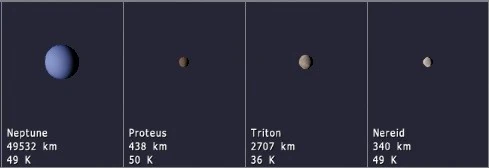
There are 8 known inner moons orbiting Neptune. The inner moons of Neptune are quite akin to Uranus's inner moons as it both orbits close to the equatorial plane of their planet (with the exception of Naiad), being dark objects as they having a very low geometric albedo varying from 7 to 10%,[22] certain inner moons shepherd their planet's ring system, and so forth. Almost all the inner moons, besides Hippocamp and Proteus, experience a gradual decrease in their distance to Neptune due to tidal deceleration as they orbit faster than their planet rotates. In the future, all of the inner moons except the outer two may get fragmented to form the new rings of Neptune or burn up in reentry as they orbit too close to Neptune's atmosphere. The inner moons, arranged by distance from Neptune: Naiad, Thalassa, Despina, Galatea, Larissa, Hippocamp, and Proteus. Naiad is the innermost moon of Neptune, and its orbit is very inclined in reference to the rest of the inner moons. Naiad participates in a peculiar 73:69 orbital resonance with its relatively close, outer inner moon known as Thalassa. From Thalassa's perspective, Naiad seems to create a zigzag pattern, repeating every time Naiad gains four laps on Thalassa.[23] Despina and Galatea both "shepherd" the ring particles of the Le Verrier ring and Adams ring as they orbit close by from both of the rings, although Galatea may be the cause of peculiar ring arcs on Adams ring, caused by numerous orbital resonances.[24] Larissa was discovered two times, first by an observation of a close stellar occultation with Neptune, but was lost until Voyager 2 recovered the moon again. Hippocamp was formed through a cometary collision event, creating the Pharos crater on the Neptunian moon Proteus,[25] which is the second-largest moon of Neptune after Triton.
Triton is quite unusual compared to the rest of the moons in the Solar system, as it orbits in a direction opposite to their planet, the similarity of the Kuiper belt objects such as Pluto, being the largest irregular satellite of the Solar system, and etc. It's widely accepted that Triton used to be a binary Kuiper belt object, similar to Pluto with its binary partner Charon. Triton's orbit got greatly interfered by Neptune, whose rapidly migrating outward during the early Solar system, at one encounter with Neptune, Neptune's enormous gravitational influence overcomes Triton's binary system, causing the Triton's binary partner to get ejected off. Subsequent to this, Triton's orbit was elliptical, with its massive influence destroying the original Neptunian moons, forming a dust disk made out of the remnants from the original regular satellites. The dust disk slowed down Triton's orbit enough to be circular and after the disk has dissipated, the debris reaccreted from the material to form the inner moons of Neptune.[26] It is the seventh largest moon in the Solar system, large enough for its shape to be collapsed by into a spheroid and has a surface mostly of nitrogen ice. Among the few moons in the Solar system that are known to be geologically active is Triton. Because of this, the surface has not many impact craters and a relatively youthful age, with a complicated geological history shown in intricate tectonic and cryovolcanic terrains. The large southern polar cap, ancient cratered plains intersected by graben and scarps, and more recent structures most likely created by endogenic processes like cryovolcanism are some of Triton's surface features.[27] There is a substantial atmosphere on the moon, mostly composed of nitrogen with trace quantities of carbon monoxide and methane,[28] and features tenuous clouds made up of condensed nitrogen ice particles from few kilometers above Triton's surface.[29] With a surface temperature of around 38 K (−235 °C; −391 °F), Triton is among the Solar system's coldest bodies.[28]
Neptune has 8 known irregular moons in total (6 in SE as of the present moment). All of Neptune's irregular moons (excluding Triton) are subjected to the Kozai mechanism, which means that it experiences constant orbital perturbations from the neighboring planets and the sun itself, as they orbit Neptune from a greater distance than any moon in the Solar system. The reason they orbit their planet at a considerably large distance is because Neptune's hill sphere is sufficiently massive for any planet in the Solar system. Even though Jupiter is the most massive planet in the Solar system, its orbit is closer to the sun than Neptune is, so its hill sphere is much smaller due to the sun significantly overcoming Jupiter's gravitational influence, although Neptune's greater distance from the sun contributes to its large hill sphere as the sun's influence didn't affect Neptune's hill sphere significantly.[30] Neptune's irregular moons in order from distance from its planet, averaged over a 30,000-year period: Triton, Nereid, Halimede, Sao, S/2002 N 5, Laomedeia, Psamathe, Neso, and S/2021 N 1. They originated from objects that encountered Neptune's gravitational influence and got captured by the planet in the process during the early Solar system. The largest of them all is Triton, which nearly compromise all the mass of the system by over 96.74%, while the rest of the Neptunian moons compromise only 3.26%. It is believed that during Triton's post-capture, It ejected Nereid into a further, highly elliptical orbit, which is thought to be the original Neptunian regular moons that survived during Neptune's capture of Triton. Nereid compromise 98% of the mass of the Neptunian irregular satellite system (excluding Triton).[31] The moon orbits in a prograde fashion, at a low inclination compared to the other irregular moons, and it has the most highly elliptical out of any natural satellite, with a eccentricity of 0.751.[32] Nereid doesn't have any discovered collisional family, similar to Halimede, although Halimede's similar color to Nereid suggested that the moon may once formed by a collision occurred on Nereid,[33] and has a high probably collision by about 41% in the entire Solar system's existence.[34] Halimede orbits in retrograde, in contrast to Nereid.
Further out from the Neptunian system, there are two collisional families, with the first closest one being the Sao group. It has only three objects in total within the group, which are Sao, S/2005 N 5, and Laomedeia, thought to have formed from a collisional event that occurred, probably on Sao since it is the largest member of the group, with a diameter of about 44 km (27 mi), hence the name.[35] The Sao group orbits in moderately eccentric, high-incline, prograde orbits. One of the moons in this group, S/2005 N 5, (formerly known as c02N4), was used to thought to be a centaur or an irregular satellite candidate. It was originally spotted in 2002, although prior to its observation, there were numerous failed attempts to recover the object until it was rediscovered in 2021 and announced in 2024. Laomedeia is one of the members in the Sao group, orbiting at a distance of about 23 million km (14 million mi) from Neptune. The last and most distant collisional family in the Solar system is the Neso group. The Neso group has three moons overall, which are Psamathe, Neso, and S/2021 N 1, akin to the Sao group moon count. Similar to how the Sao group was created, the Neso group is believed to have been formed through a collision with a much larger satellite, possibly Neso, thus being the group's namesake.[36] The Neso group orbits in a moderately eccentric, high-incline, prograde orbit. Psamathe is one of the irregular moons of Neptune, who is a member of the Neso group, with an average distance from Neptune longer than Mercury's average distance to the sun, similar to Neso, who's the largest member of the group by about 60 km (37 mi) in diameter. The current outermost moon of Neptune in general is S/2021 N 1. It has the most distant, smallest, faintest, and longest orbital period of any moon in the Neptunian system. S/2021 N 1 was discovered in 2021 and announced in 2024.
Rings
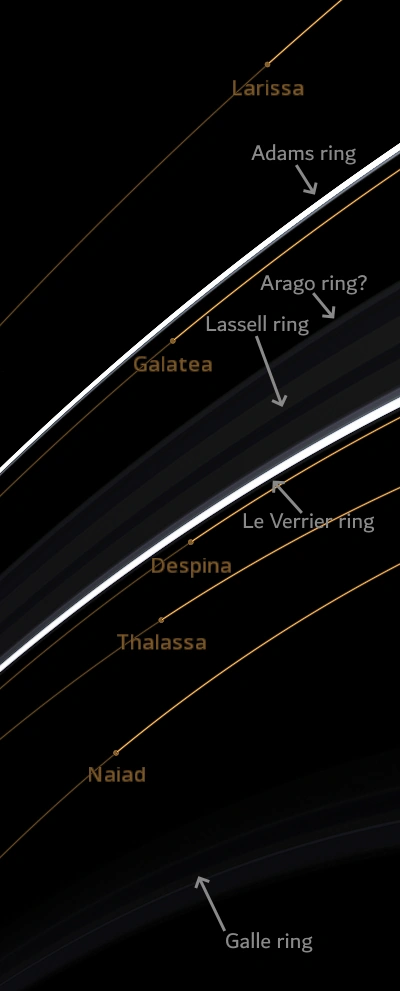
Neptune's ring-moon system
The ring system of Neptune comprises of 5 pair of rings in ordered from distance to Neptune that are, the Galle ring, Le Verrier ring, Lassell ring, Arago ring, and Adams ring. Neptune's rings are believed to be quite young, similar to those of Uranus; they are most likely much younger than the Solar System.[27] Neptune's rings probably originated from the collisional breakup of former inner moons. Moonlet belts are produced by these occurrences and serve as the rings' primary suppliers of dust. The weak dusty bands that Voyager 2 saw in between Uranus's main rings and the rings of Neptune are comparable in this regard.[27] The rings' reddish color is most likely due to the possibility that they are made of ice particles covered in silicates or carbon-based substances. It is likely that a mixture of radiation-processed organics and ice makes up the dark material that makes up Neptune's rings.[27] The names of Neptune's rings are named after astronomers who are affiliated with Neptune and its system.
The Galle ring, the innermost ring, named after Johann Gottfried Galle, who was the first to observe Neptune using a telescope in 1846.[37] It is a broad, faint ring that orbits 41,000–43,000 km (25,476–26,718 mi) away from Neptune. It is around 2,000 km (1,242 mi) wide. The Le Verrier ring is named after Urbain Le Verrier, which estimated Neptune's location in the sky in 1846.[38] It is a narrow, dense ring with an confined orbital radius of approximately 53,200 km (33,056 mi) and a width of about 113 km (70 mi).[39] Despina, one of the inner moons that orbits just inside it at 52,526 km (32,638 mi), could have a role in the ring's confinement as a shepherd.[40] The Lassell ring, frequently referred to as the plateau, is the widest ring in the Neptunian ring system.[41] It's named after William Lassell, an English astronomer who discovered Triton, Neptune's largest moon.[42] The Lassell ring is a faint sheet of material located between the Le Verrier ring at approximately 53,200 km (33,056 mi) and the Arago ring at 57,200 km (35,542 mi). The Arago ring is named after François Arago, a French mathematician, physicist, astronomer, and politician; it was identified from a minor peak of brightness at the outermost boundary adjacent to the Lassell ring; however, various other sources fail to mention the Arago ring at all. It is less than 100 km (62 mi) broad and 57,200 km (35,542 mi) away from Neptune.
The outermost ring of Neptune, Adams ring is named after John Couch Adams, which predicted Neptune's location separately from Le Verrier.[43] This ring has a total width of around 35 km or about 21 mi (15–50 km [9–31 mi] ) and is thin, inclined, and slightly eccentric.[39] Through a 42:43 outer Lindblad resonance, Neptune's inner moon Galatea, which orbits just inside the Adams ring at 61,953 km (38,495 mi), functions as a shepherd, containing ring particles inside a tight range of orbital radii.[24] Galatea's mass has also been estimated using the influence it has on the Adams ring.[44] It is the most well-documented ring of Neptune due to the five bright arcs it has. Within the ring, the arcs are distinct areas where the ring particles that make up the ring are enigmatically grouped together. The arcs have remained stable for decades since their discovery, and they have been given names, which are Fraternité, Égalité 1, Égalité 2, Liberté, and Courage. There is still no explanation for the Adams ring's arcs. Orbital dynamics suggest that they should disperse into a uniform ring within a few years, which makes the existence of them baffling. Regarding the confinement of the arcs, several hypothesis have been proposed. The most common hypothesis states that Galatea utilizes the 42:43 outer Lindblad resonance to constrain the arcs, although later observations suggest that Galatea may not be in an orbital resonance with the Adams ring.[24]
Discovery
Neptune is too dim to be observed with the naked eye. The invention of the telescope made the observation of this celestial body possible, but it was not identified as a planet until 1846. In fact Galileo Galilei himself had already seen Neptune, but he assumed that it was a blue fixed star. After the discovery of Uranus by William Herschel in 1781 scientists monitored the orbit of the newly discovered planet for several decades and they noticed irregularities that seemed to contradict the Newtonian Law of Gravitation. The astronomer Urbain Le Verrier realized that these perturbations could have been caused by another planet orbiting even further beyond than Uranus and eventually published a theoretical prediction of the planet's position. The British astronomer and mathematician John Adams reached the same conclusion independently, which sparked a search for the new planet. After a British team of astronomers had made several attempts to observe this mysterious planet it was the German astronomer Johann Galle who - from the Berlin Observatory - observed Neptune for the first time knowing that it was a planet. Le Verrier had sent him his papers when he realized that no astronomer in the French scientific community was interested in the project. This marked a new development that deeply influenced the way astronomy was conceived and practiced. A planet had been discovered "on paper", which was a huge achievement for the theoretical branch of astronomy, and Newton's gravitational theory had been confirmed beyond a reasonable doubt.[45]
|
Richard Feynman on the discovery of Neptune, from Lecture on Gravitation |
|
|---|


Exploration
Voyager 2 conducted the closest and only flyby to Neptune on 25 August 1989. It examined and discovered a famous anticyclone storm known as the Great Dark Spot on Neptune's atmosphere, six inner moons orbiting Neptune, which are Naiad, Thalassa, Despina, Larissa, Galatea, and Proteus, in which Larissa and Proteus are captured in moderate detail,[46][47][48] a system of previously overlooked Neptunian rings, etc. Regardless of the effects on the trajectory, it opted to conduct a close flyby of the moon Triton because Neptune was the final major planet the spacecraft could visit. Voyager 2 performed the closest flyby to Triton five hours after its closest approach to Neptune. It was noticed that Triton's geological features are young, as its surface features little to no impact craters but instead active cryovolcanic activity, a thin atmosphere made mostly of nitrogen, large polar ice caps, and its "cantaloupe-like" terrain.[49] The first precise measurement of Neptune's mass was obtained during the fly-by of the Neptunian system, and it was discovered to be 0.5 percent lower than previously estimated. The theory that an as-yet-undiscovered Planet X affected Neptune and Uranus' orbits was refuted.[50] It was found out that Neptune's magnetic field is displaced from its core and has a greater tilt, and its aurorae are much weaker than Earth's according to observations from Voyager 2.[3] Ever since then, no other spacecraft has visited Neptune. Studying Neptune now relies on utilizing ground-based observatories, such as the W. M. Keck Observatory on Hawaii or a space telescope such as the Hubble space telescope, which orbits in a low Earth orbit.
Images


Sources
- ↑ The sections "Interior structure", "Motion" and "Neptunian system" have been adapted from the Space Engine ingame wiki.
- ↑ https://archive.org/details/uranusneptuneplu00elki/page/79
- ↑ 3.0 3.1 https://ui.adsabs.harvard.edu/abs/2004Natur.428..151S
- ↑ https://zenodo.org/record/1230994
- ↑ https://doi.org/10.1086%2F116119
- ↑ http://lasp.colorado.edu/~bagenal/3750/ClassNotes/Class12/Class12.html
- ↑ https://ui.adsabs.harvard.edu/abs/1991JGR....9618921P
- ↑ https://ui.adsabs.harvard.edu/abs/1993ARA&A..31..217L
- ↑ https://web.archive.org/web/20210929080319/https://books.google.com/books?id=RaJdy3_VINQC&pg=PA224&lpg=PA224&dq=planet+neptune+heat+flow
- ↑ https://ui.adsabs.harvard.edu/abs/2002AJ....123.2862T
- ↑ http://www.geotimes.org/june05/WebExtra060705.html
- ↑ https://ui.adsabs.harvard.edu/abs/2008Icar..196..258L
- ↑ http://www.psrd.hawaii.edu/Aug01/bombardment.html
- ↑ http://www.space.com/18922-neptune-atmosphere.html
- ↑ http://solarsystem.nasa.gov/planets/neptune/indepth
- ↑ https://www.researchgate.net/publication/234243535_Heating_of_Neptune's_Thermosphere_by_the_Magnetospheric_Convection_Electric_Field
- ↑ http://www.universetoday.com/22070/surface-of-neptune/
- ↑ https://web.archive.org/web/20110728200555/http://cseligman.com/text/sky/rotationvsday.htm
- ↑ https://web.archive.org/web/20071201013047/http://www.oca.eu/morby/papers/6166a.pdf
- ↑ https://minorplanetcenter.net//iau/lists/TNOs.html
- ↑ https://archive.org/details/beyondplutoexplo00davi/page/104
- ↑ https://ui.adsabs.harvard.edu/abs/2003Icar..162..400K/abstract
- ↑ https://www.jpl.nasa.gov/news/nasa-finds-neptune-moons-locked-in-dance-of-avoidance
- ↑ 24.0 24.1 24.2 https://ui.adsabs.harvard.edu/abs/1991Sci...253..995P/abstract
- ↑ https://hubblesite.org/contents/news-releases/2019/news-2019-04.html
- ↑ https://www.sciencedirect.com/science/article/abs/pii/001910359290155Z?via%3Dihub
- ↑ 27.0 27.1 27.2 27.3 https://zenodo.org/records/1230992
- ↑ 28.0 28.1 http://occult.mit.edu/_assets/documents/publications/Elliot2000Icarus143.425.pdf
- ↑ https://web.archive.org/web/20071220005501/http://voyager.jpl.nasa.gov/science/neptune_triton.html
- ↑ http://www2.ess.ucla.edu/~jewitt/papers/2007/JH07.pdf
- ↑ https://tilmanndenk.de/outersaturnianmoons/
- ↑ https://web.archive.org/web/20111014234918/http://ssd.jpl.nasa.gov/?sat_elem
- ↑ https://ui.adsabs.harvard.edu/abs/2004ApJ...613L..77G/abstract
- ↑ https://www.cfa.harvard.edu/~mholman/nature_final.pdf
- ↑ https://carnegiescience.edu/new-moons-uranus-and-neptune-announced
- ↑ https://ui.adsabs.harvard.edu/abs/2006AJ....132..171S
- ↑ https://ui.adsabs.harvard.edu/abs/1910Obs....33..311.
- ↑ https://www.nature.com/articles/016462a0
- ↑ 39.0 39.1 https://ui.adsabs.harvard.edu/abs/1990GeoRL..17.1745H/abstract
- ↑ https://www.britannica.com/topic/Despina
- ↑ https://www.astro.umd.edu/~hamilton/research/preprints/BurHamSho01.pdf
- ↑ https://doi.org/10.1093%2Fmnras%2F41.4.188
- ↑ https://doi.org/10.1093%2Fmnras%2F53.4.184
- ↑ https://arxiv.org/abs/2204.01063
- ↑ https://en.wikipedia.org/wiki/Discovery_of_Neptune
- ↑ http://www.cbat.eps.harvard.edu/iauc/04800/04806.html
- ↑ http://www.cbat.eps.harvard.edu/iauc/04800/04824.html
- ↑ http://www.cbat.eps.harvard.edu/iauc/04800/04867.html
- ↑ https://science.nasa.gov/resource/tritons-cantaloupe-terrain/
- ↑ http://www.nasaspaceflight.com/2011/08/thirty-four-years-voyager-2-continues-explore/