Overview:
Charon, Pluto's largest moon (Sometimes called binary with Pluto), is a cold, rugged world in the outer Solar System. It's about half Pluto's size, with a marked surface featuring plains, mountains, and craters. Charon lacks any substantial atmosphere, resulting in extreme temperature shifts.
Discovery:
Discovered in 1978 by James W. Christy, Nothing was really known about Charon until the New Horizons spacecraft did a flyby of Pluto in 2015, offering close-up views and data about its geology.
Physical Characteristics:
Charon's surface shows various hues and features, including a significant chasm called Serenity Chasma, suggesting that there was tectonic activity in the past.
Orbital Dynamics:
Charon's orbital dynamics are deeply entwined with Pluto. Key characteristics include:
- Synchronous Rotation: Charon is tidally locked to Pluto, meaning it always shows the same face to its parent body. The mutual gravitational interaction between the two keeps one side facing Pluto while the other side remains faced away from Pluto.
- Stability: Charon's orbit around Pluto is remarkably stable, influenced by their gravitational influences. Together, they comprise a binary system, with the center of mass (barycenter) located outside Pluto's surface.
Notable Features:
- Mordor Macula: This large, reddish area on Charon's surface is known informally as Mordor Macula. It has been of particular interest due to its distinctive coloration and geological features.
- Canyons and Craters: Charon's surface has a range of geological formations, including deep canyons and impact craters.
Exploration:
The exploration of Charon has primarily occurred through NASA's New Horizons mission. On July 14, 2015, New Horizons made a historic flyby of the Pluto-Charon system, providing close-up images and invaluable data on Charon's geological and compositional properties.
Surface Composition:
The moon's surface is believed to consist of water ice mixed with tholins, complex organic compounds created by the interaction of ultraviolet light and simple molecules. These tholins likely came from Pluto which somehow managed to make its way to the Mordor Macula region on Charon. Which would explain the Red spot on Charon.
Future Exploration:
While New Horizons' flyby greatly expanded our knowledge of Charon, there is potential for further exploration. future missions in the may target Pluto's system to gain more data on this moon.
Gallery:
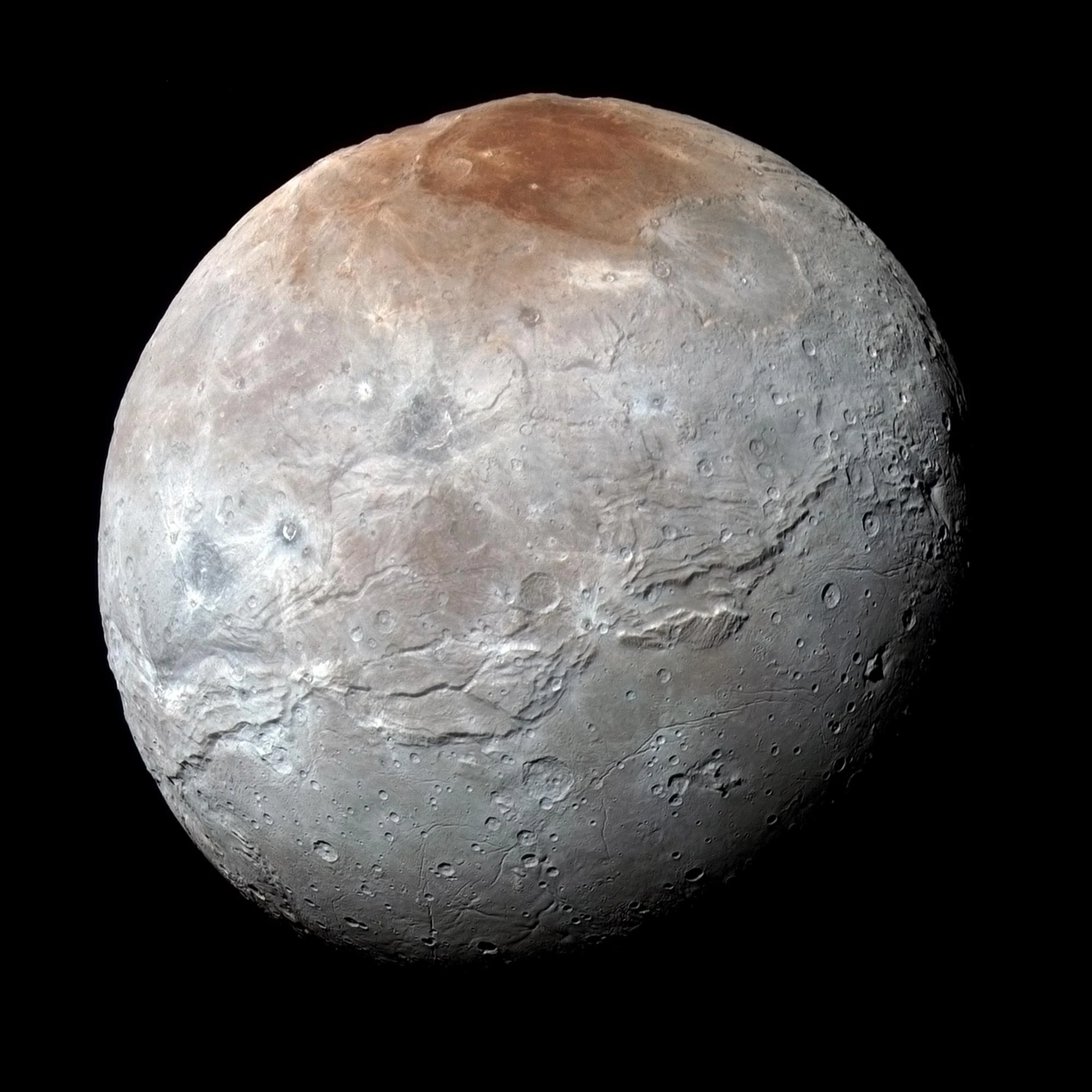

Real Image Of Charon By New Horizons.


A Map Of Charon With Landmarks.