Overview
Jupiter is the fifth planet from the sun and the largest of the Solar System, as well as the planet with the most moons. Viewed from Earth, Jupiter can reach an apparent magnitude of nearly -3m, making it the third brightest object in the night sky after the Moon and Venus. It has been considered a powerful deity for thousands of years in many mythologies due to its brightness, and modern-day explorations are proving that these ideas were more accurate than otherwise might have been assumed.[1]
Composition and Atmosphere
As a gas giant, Jupiter has nothing that could be considered a 'surface' - its atmosphere simply transitions smoothly from gas to liquid to solid as it gets deeper. It's composed mostly of hydrogen and helium, with only small amounts of other elements. Numerous storms exist on its surface at any one time, notably the Great Red Spot, an anticyclonic storm the size of the Earth which has been active for at least three hundred years.


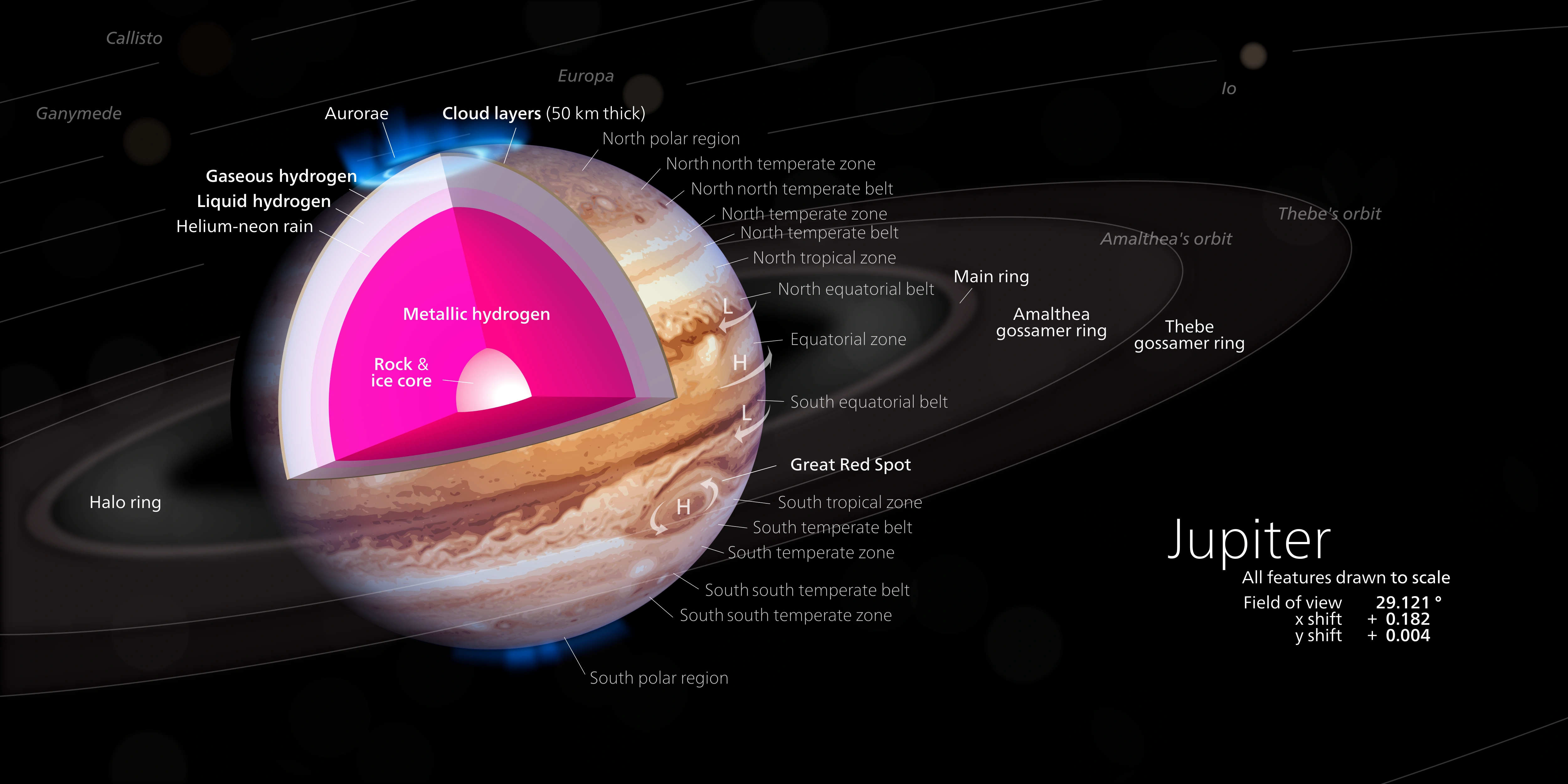

A diagram showing the interior structure of Jupiter andd the nomenclature of the various regions of its outer atmosphere
Animation- diving into Jupiter's clouds
Moons
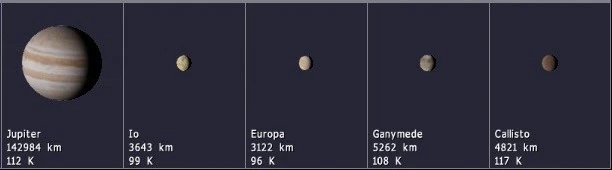
Jupiter's first four moons were discovered by Galileo Galilei in 1610, and today are known as the 'Galilean' moons in his honor - of its total of 67 moons, the Galilean moons are the largest and most massive, making up 99.9997% of the total mass in orbit around Jupiter, and all except Europa are larger than the Earth's moon. The remaining 63 moons are very small by comparison, barely more than asteroids. The innermost Galilean moon, Io, is currently the only location in the solar system other than the Earth to exhibit active volcanism. Second is Europa, the smallest of the Galilean moons, covered in a shell of thick ice and theorized to possess an ocean of liquid water underneath this ice sheet. Third and Fourth are Ganymede and Callisto, respectively. Both are composed mostly of water ice, and may also hold subsurface oceans like Europa.

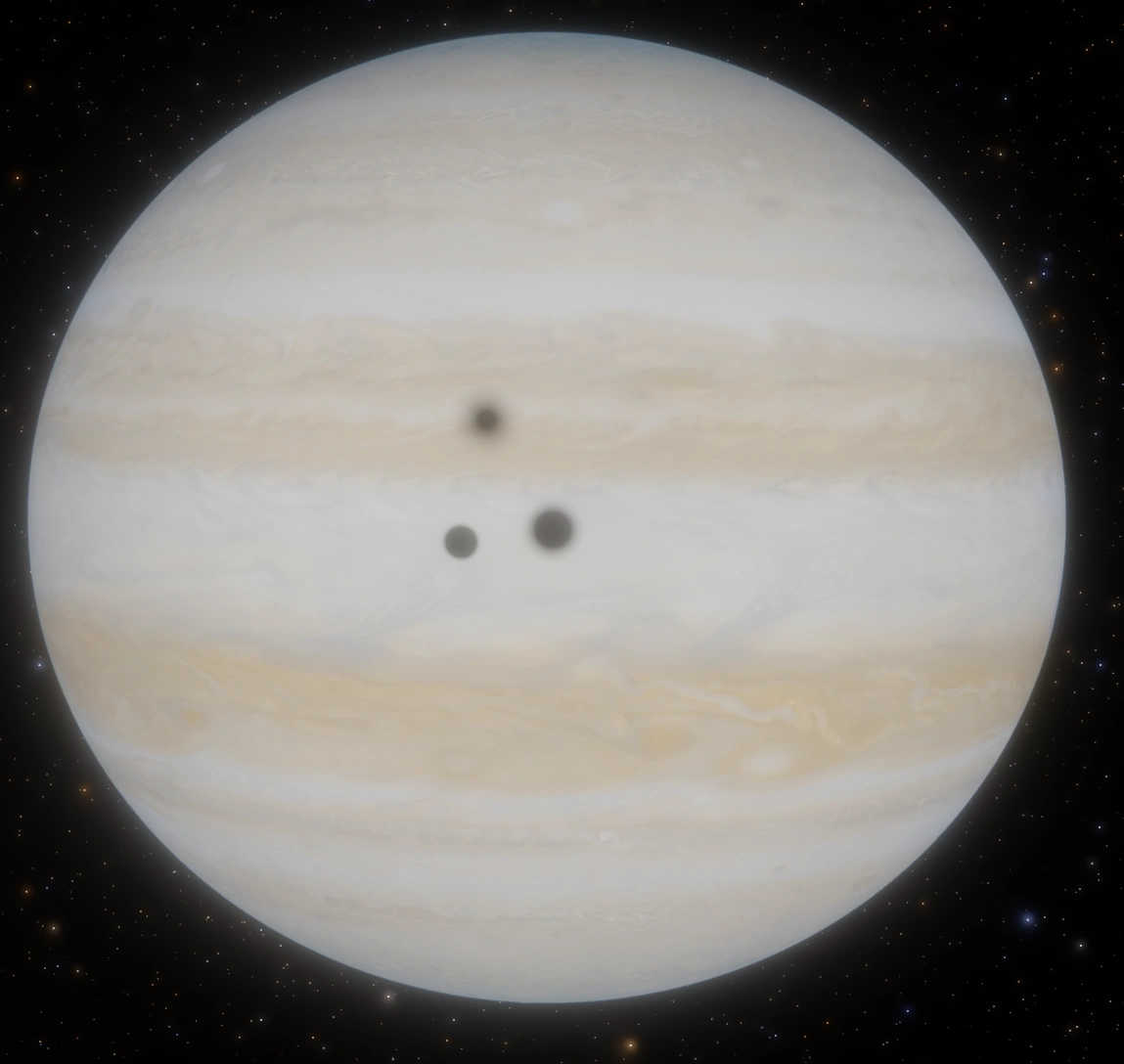
Triple Eclipse
On SE Planetarium there's a triple eclipse on Jupiter, it involves 3 moons (closest to farthest) Io, Ganymede, and Callisto
Rings
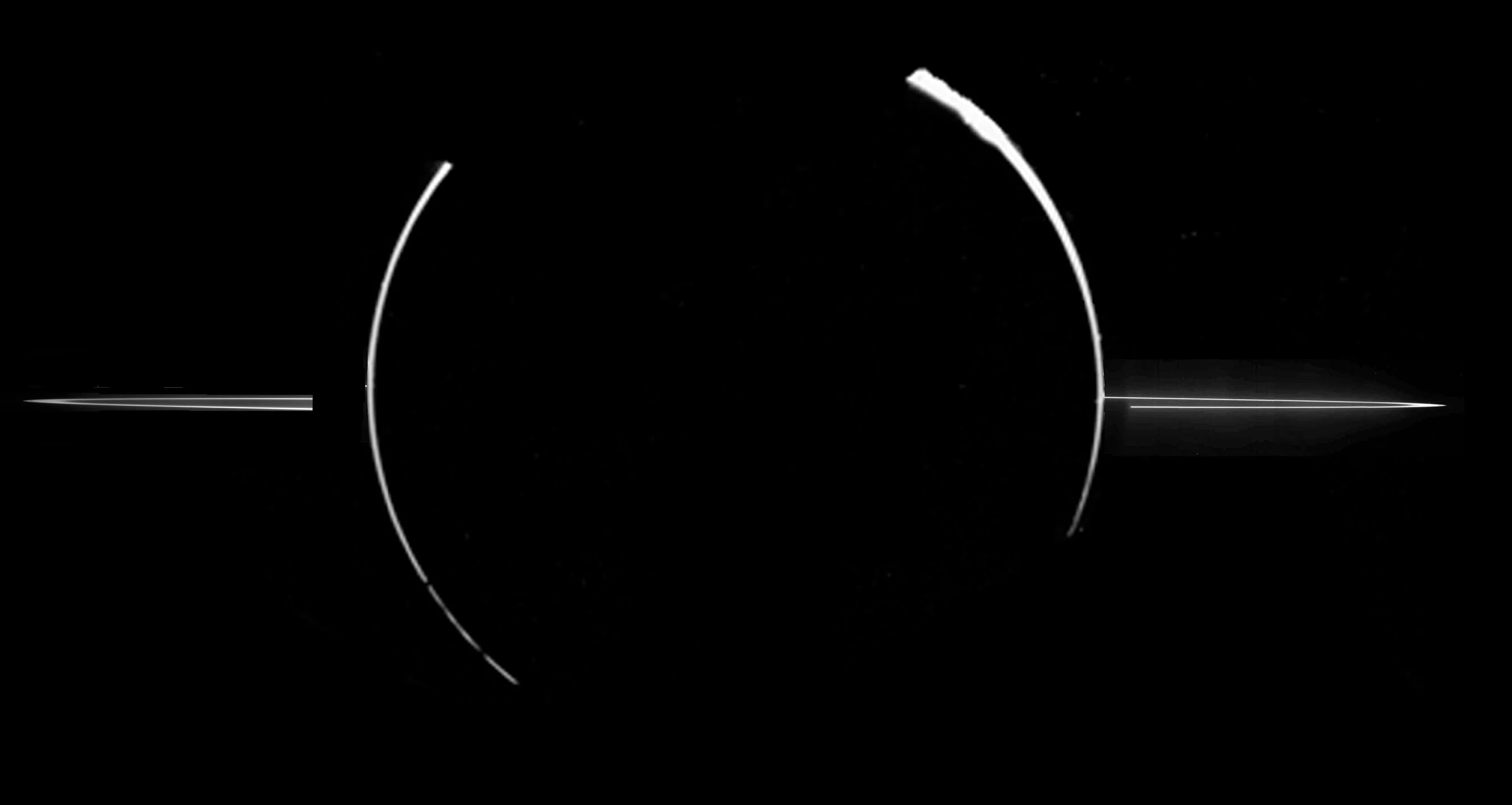
Just like all of the major planets in the solar system, Jupiter also contains a thin ring system that is not visible to the naked eye, This also means trying to observe Jupiter's rings in its shadow is futile, However, You can see Jupiter's rings in the Infrared & Ultraviolet wavelength.

Orbit
Jupiter occupies a typical circular orbit, with a semi-major axis of 5.2 AU, an inclination of 1.3°, and a low eccentricity value of 0.04.
Exploration
Jupiter wasn't explored directly until 1973, when Pioneer 10 conducted a flyby, returning the first images from beyond the orbit of Mars. Pioneer 10 was followed a few months later by Pioneer 11 (which later went on to explore Saturn). In 1979, the twin Voyager probes arrived. In 1992, the Ulysses probe used Jupiter's strong gravity to alter its trajectory, allowing it to pass over the poles of the Sun a few years later. In 1995, the Galileo spacecraft became the first to orbit Jupiter, and operated continuously until 2003, when it was intentionally crashed into the atmosphere to avoid any chance of the inactive spacecraft impacting (and contaminating) Europa. The Cassini spacecraft, en-route to Saturn, conducted a flyby in 2000, returning the highest resolution imagery of Jupiter to date. Finally, in 2007, the New Horizons spacecraft en-route to Pluto conducted a flyby of Jupiter, testing its instruments to help prepare for the Pluto encounter in 2015.
- ↑ This article has been adapted from the Space Engine ingame wiki
Images


