Overview:
Telesto is a moon of Saturn and is a trojan moon of a larger moon Tethys. This article provides a comprehensive overview of Telesto, exploring its discovery, physical characteristics.
Physical Characteristics:
- Location and Trojan Relationship: Telesto is situated in a gravitational point known as Lagrange points, specifically in Tethys' leading Lagrange point (L4). This position allows Telesto to maintain a stable orbit as it moves along with Tethys in its path around Saturn.
- Size and Appearance: With a diameter of approximately 24 kilometers (15 miles), Telesto is a relatively small moon. Its surface appears bright and reflects sunlight effectively.
Exploration:
- Discovery: Telesto was discovered on October 8, 1980, by the Voyager 1 spacecraft during its mission to the outer planets and its identification as a trojan moon.
- Cassini-Huygens Mission: The Cassini spacecraft, launched in 1997 and arrived at Saturn in 2004 and for many years after study the many moons of saturn, including Telesto.
Other Notable Features:
- Trojan Moons and Resonance: Telesto's as a trojan moon, sharing its orbit with Tethys, is an example of orbital resonance. The Lagrange points offer stable locations where smaller bodies can exist alongside larger ones.
Gallery:
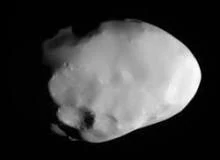

A Real Image Of Telesto Taken By The Cassini Spacecraft.