Definition
With a diameter of 3121 km, Europa (also known as Jupiter II) is the second and smallest of the four major satellites of the planet Jupiter and the sixth largest in the Solar System. Although the temperatures on its surface reach a maximum of 123 K, it is assumed that under a crust of water ice there could be a liquid water ocean measuring over 100 km in depth. Europa's discovery is attributed to the Italian polymath Galileo Galilei, who in 1610 directed his rudimentary telescope at Jupiter. The four great moons Io, Europa, Ganymede and Callisto, which were discovered on this occasion, are also referred to as the Galilean moons. The moon was named after Europa, who in Greek mythology was a Phoenician princess seduced, abducted and brought to the shores of Crete by an enamoured Zeus disguised as tame white bull[1]. Although the scholar Simon Marius had already suggested the name Europa shortly after the moon's discovery, it didn't gain widespread acceptance. It was only in the middle of the 20th century that it came back into use. Previously Roman numerals were used to designate the Galilean moons and Europa was hence referred to as Jupiter II. The Galilean moons are so bright that they can be observed with binoculars or small telescopes.[2]
Orbit and rotation
Europa orbits Jupiter at an average distance of 670,900 km with an orbital period of 3 days, 13 hours and 14.6 minutes. Its orbit is nearly circular, as the extreme points where the orbital distance is farthest and closest (Perijove and Apojove) differ only by 1.01% from the semimajor axis. The orbital plane is inclined by only 0.470° with respect to the equatorial plane. The orbital resonance between Europa and its inner and outer neighbor is respectively 2: 1 and 1: 2; During two rotations of Europa Io completes exactly four orbits and Ganymede exactly one. Europa, like Earth's Moon and the rest of the inner Jupiter moons, is tidally locked to its parent body.


An animation that shows Europa's orbital speed in comparison to Io and Ganymede
Structure and physical properties
Europa has an average diameter of 3121.6 km and an average density of 3.01 g / cm³. Although it is by far the smallest of the four Galilean moons, its mass is greater than the combined mass of all the smaller moons of the solar system. The temperature on Europa's surface is only 110 K at the equator and 50 K at the poles.
Surface
With an albedo of 0.64, Europa has one of the brightest surfaces of all known moons in the Solar System: 64% of the irradiated sunlight is reflected. The surface is mainly composed of water ice and its colour variations are associated with differences in geologic feature type and location. For example, areas that appear blue or white contain relatively pure water ice, while reddish and brownish areas include non-ice components in higher concentrations.[3] It is also exceptionally smooth, despite being covered by shallow furrows. The number of structures that rise above their surroundings by more than a few hundred meters is exiguous. Very few impact craters are visible on Europa, of which only three have a diameter exceeding 5 km. The second largest crater, Pwyll, has a diameter of 26 km. Pwyll is one of the geologically most recent structures on Europa. It was created by a violent impact that ejected light material from the ground over distances of thousands of kilometres. The low cratering rate is an indication that Europa's surface is geologically very young. Estimates of the impact frequency of comets and asteroids yield a maximum age of 30 million years. Europa's most striking feature is a network of scattered trenches and furrows that cover the entire surface called lineae (singular: linea). They have a strong resemblance to cracks and distortions found in terrestrial ice fields. The larger ones are about 20 km wide and have indistinct outer edges as well as an inner area made of bright material. Possible causes of these lineae are cryovolcanism (cold volcanism) or the eruption of warm water through geysers, which could have fractured the ice crust. The lineae are, for the most part, not located in areas where they are expected to be. To explain this, it was conjectured that there is an ocean between the ice crust and the lunar surface. This ocean could have arisen due to the eccentric orbit of the Moon around Jupiter, which continually changes the Jovian gravitational effect on Europa so that it is constantly deformed. This increases the interior temperature of Europa, melting a portion of its water ice crust.
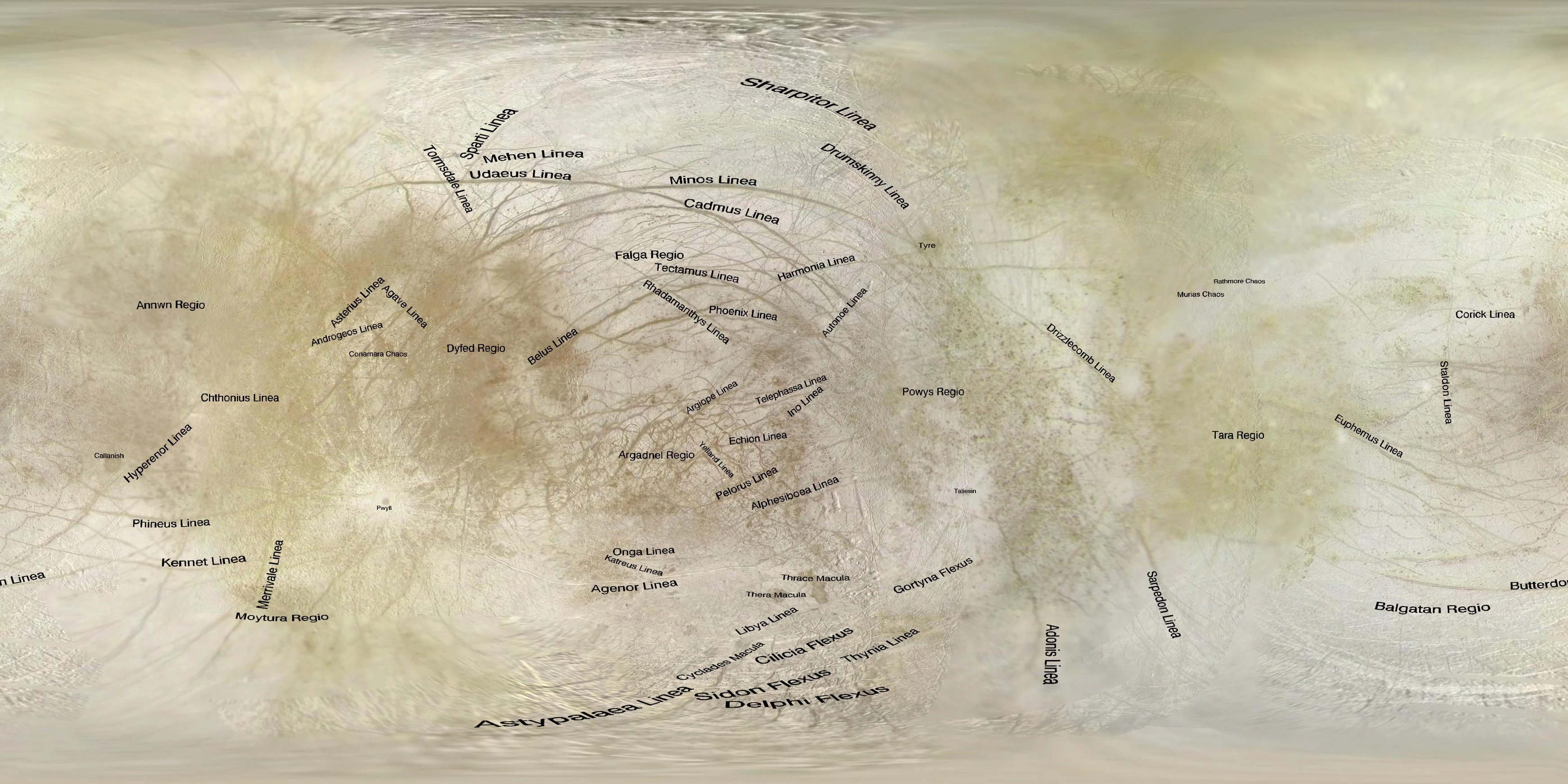

Map of Europa's surface
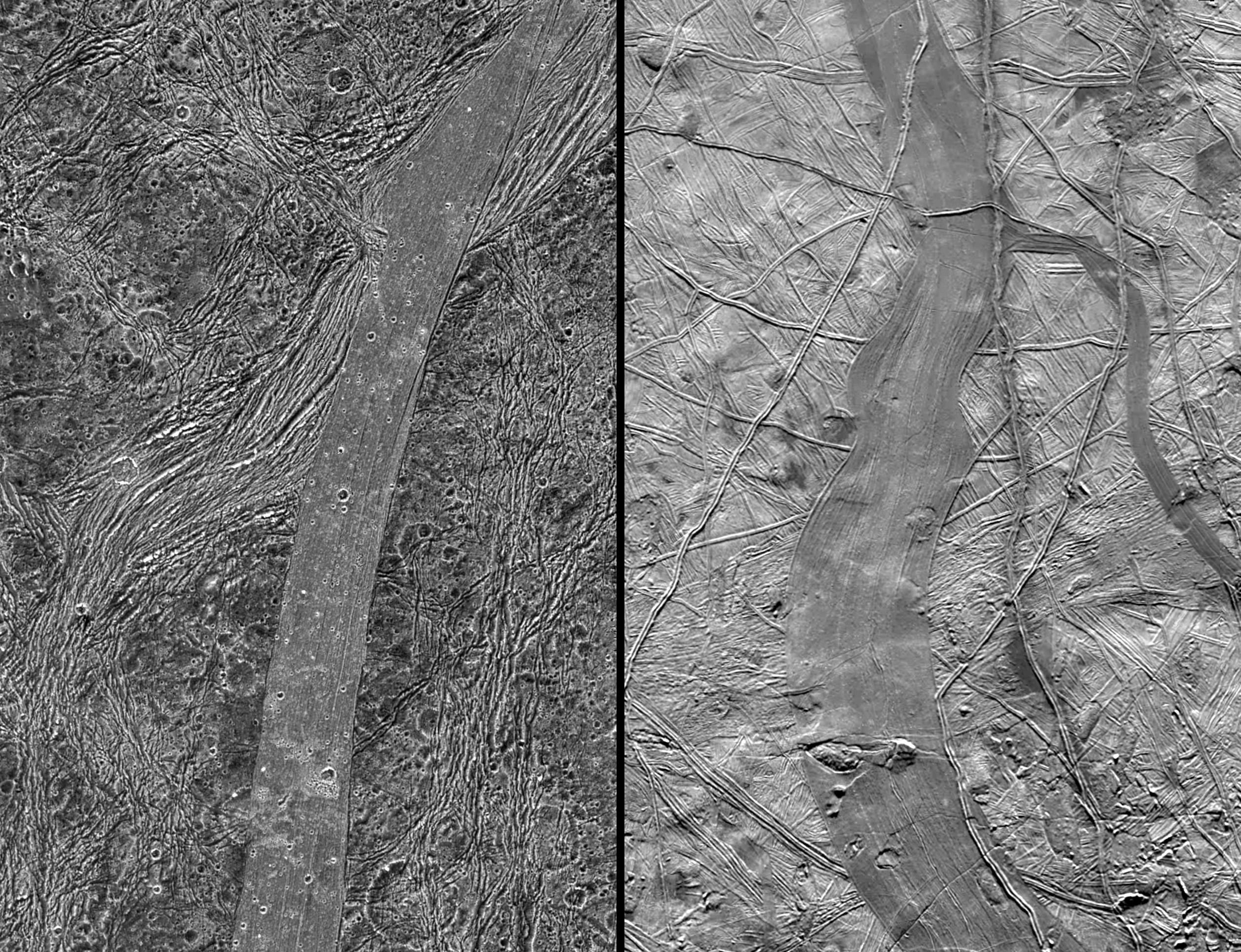

This image, taken by NASA's Galileo spacecraft, shows a same-scale comparison between Arbela Sulcus on Jupiter's moon Ganymede (left) and an unnamed band on Europa (right)
Ice deposits and ocean
The smooth surface and its features are not dissimilar to ice fields found in Earth's polar regions. It is assumed that Europa's crust of water ice envelops an ocean of liquid water, which is heated by the effect of tidal forces. This would contrast greatly with the surface conditions, where due to low temperatures water ice is hard as rock. The largest visible craters were obviously filled with fresh ice and levelled over time. This mechanism as well as calculations on the warming caused by tidal forces suggest that Europa's ice crust has a thickness of about 10-15 km. However, there could be water bubbles only about 3 km below the outer surface. The underlying ocean could have a depth of up to 100 km. Thus, the amount of water it contains could be more than double that of Earth's oceans. Detailed shots show that parts of the ice crust have shifted and shattered, creating a pattern of ice fields. The movement of the crust is caused by tidal forces which raise and lower the surface by about 30 m. The ice fields should have a certain, predictable pattern due to the tidal rotation. Detailed shots show, however, that only the geologically recent areas display such a pattern. Other areas deviate from this pattern with increasing age. This discrepancy can be explained with the slightly faster motion of the surface in comparison to the inner mantle and core. The ice crust is mechanically decoupled from the moon by the intermediate ocean and is influenced more intensely by Jupiter's gravitational forces. Comparisons of the images shot by the spacecrafts Galileo and Voyager 2 show that Europa's ice crust moves around the moon once in about 10,000 years.
Interior structure
The moon is similar in structure to the terrestrial planets, as it is mainly composed of silicate rocks. Its outer layer consists of water with an estimated thickness of 100 km. In addition, it may have a relatively small nickel-iron core.
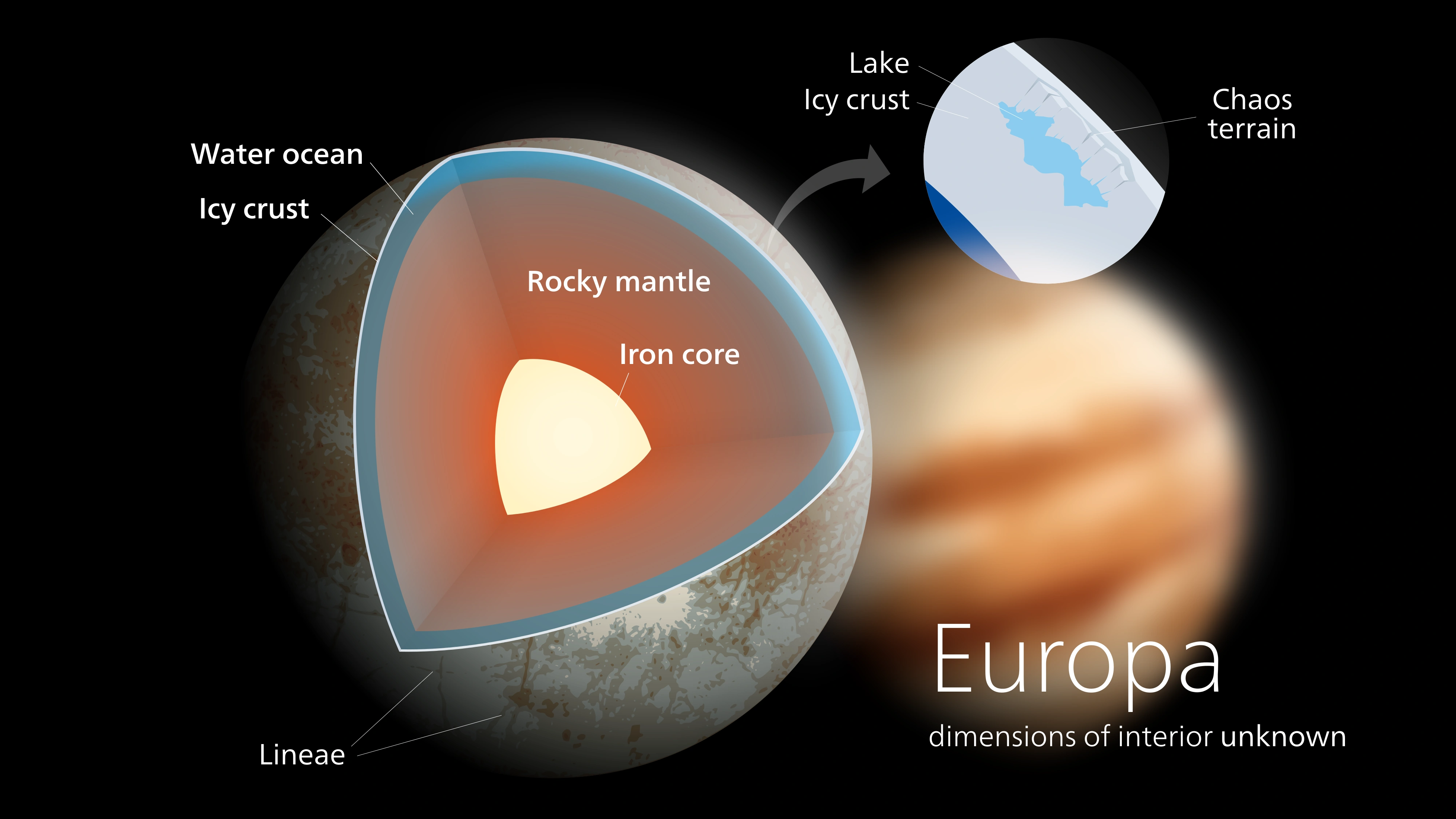

Diagram of Europa's interior structure
Atmosphere
Images recorded by the Hubble spacecraft have provided evidence for the existence of an extremely thin oxygen atmosphere with an estimated average pressure of 10⁻¹¹ bar. It is assumed that this oxygen is the result of solar radiation hitting the surface and splitting water ice into hydrogen and oxygen. The volatile hydrogen escapes into space while the oxygen, being higher in mass, is held by Europa's gravitation.
Magnetic field
During passages of the Galileo spacecraft a weak magnetic field was measured (its strength is about ¼ of the Ganymedean field). The magnetic field varies as Europa moves through the very pronounced Jovian magnetosphere. Data from Galileo indicates that there is an electrically conductive liquid under the surface of Europa, such as an ocean of salt water. Moreover, spectroscopic analyses show that the reddish lines and structures on the surface are rich in salts, such as magnesium oxide. The salt deposits might be remnants of erupted and subsequently evaporated salt water. Since the ascertained salts are generally colourless, other elements such as iron or sulphur may be responsible for the reddish coloration.
Habitability
The possible presence of liquid water caused speculation as to whether life could exist in Europa's oceans. On Earth, organisms have been discovered that can exist under extreme conditions even without the presence of sunlight, for instance in hydrothermal sources ("black smokers") or in the deep sea. According to a report published in the science magazine New Scientist, NASA scientists who planned the cancelled Nasa mission "Jupiter Icy Moons Orbiter" concluded - after evaluations of earlier missions conducted during spring 2004 - that Europa could be far more hostile than previously assumed. Hydrogen peroxide and concentrated sulfuric acid were detected on the surface. In this article, it was assumed that the acid originated in the subglacial ocean. Its high concentration was explained by underwater volcanism, which can be responsible for the emission of sulphur. The space probe Galileo, which had monitored Europa most recently, was directed into Jupiter’s atmosphere and thereby incinerated to prevent the contamination of Europa with terrestrial microbial life.
Sources
- ↑ https://en.wikipedia.org/wiki/Europa_(mythology)
- ↑ This article was translated and adapted from the German ingame Space Engine wiki article. Additional information was added from other sources.
- ↑ https://www.nasa.gov/jpl/europas-stunning-surface
Images


