Overview:
Phoebe is a minor moon of Saturn, Its has many characteristics, including an irregular orbit and dark surface. This article provides an overview of Phoebe, into its physical properties, discovery, and the knowledge found from space missions.
Physical Characteristics:
- Size and Composition: Phoebe has a diameter of approximately 213 kilometers (132 miles), making it one of Saturn's larger albeit minor moons. It follows a retrograde orbit, opposite to the direction of Saturn's rotation. Its surface is a dark, reddish-brown coloration, suggesting a composition rich in complex organic molecules.
- Surface Features: Although observations from space probes such as Cassini have revealed limited details, Phoebe's surface appears to be marked by craters, ridges, and the remnants of impacts.
Discovery and Exploration:
- Discovery: Phoebe was discovered on March 18, 1899, by American astronomer William Henry Pickering.
- Cassini-Huygens Mission: The Cassini-Huygens spacecraft, which conducted an extensive exploration of the Saturnian system, provided insights into Phoebe. Flybys of Phoebe in June 2004 allowed for detailed imaging and spectroscopic analysis.
Origin and Composition:
Phoebe's retrograde orbit suggests a odd origin, potentially as a captured object from the outer solar system. It mainly has a dark surface and is rich in complex organic molecules.
Gallery:
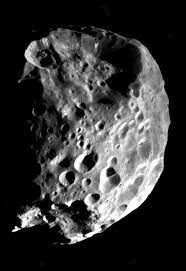

A Real Image Of Phoebe Taken By The Cassini Spacecraft.