Overview:
Pan is a small moon of Saturn and exists within the ring system, specifically the Encke gap in the A ring of Saturn. Pan has some unique features such as a ridge along its crater like other moons in the ring system and even Iapetus.
Physical Characteristics:
Pan has many features that distinguish it from alot of the other moons in the solar system. Its very small size at around 34.4 × 31.4 × 20.8 km in dimensions. Pan has an equatorial ridge have led to its designation as a "flying saucer" moon which likely caused by accretion of particles from Saturn's rings falling onto Pan.
Surface and Appearance:
While our direct observations of Pan's surface are limited, its most notable feature is its equatorial ridge. This ridge, often likened to a flattened bulge, gives the moon its saucer-like shape. Pan's surface is thought to be covered in icy materials, as is common among Saturn's moons.
Exploration:
While Pan has not been the main target of any space missions, it has been observed and studied by spacecraft exploring Saturn such as the Cassini Spacecraft. These observations have provided some data into the moon's properties and behaviour.
Scientific Insights and Origin:
Its likely That Pan formed when a moon similar in size to Mimas millions of years ago was destroyed in an event, either caused by a comet smashing into it and the binding energy of said Mimas like object was not enough to hold it together anymore, causing it to break apart. Another theory is that overtime this Mimas like object slowly got closer and closer to Saturn before eventually getting ripped up by the Roche limit of Saturn. Either way the debris from the destroyed moon eventually spread itself across Saturn and eventually formed into the rings around Saturn today. Its likely that Pan formed from this said debris over time and is likely the cause of the Encke gap.
Gallery:
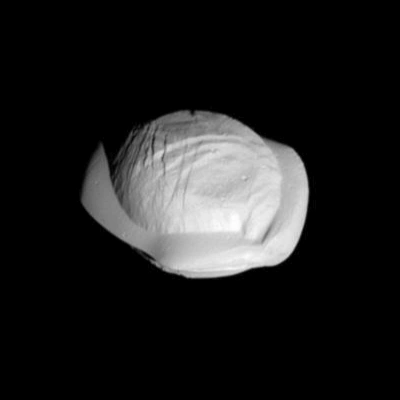

A Real Image Of Pan Taken By The Cassini Spacecraft.