Overview
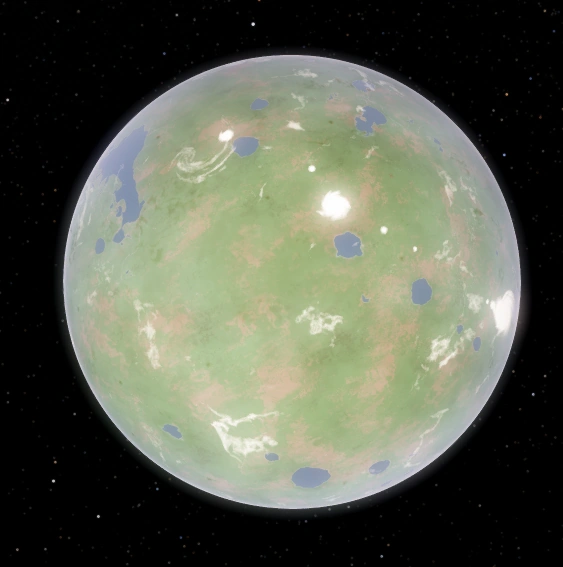
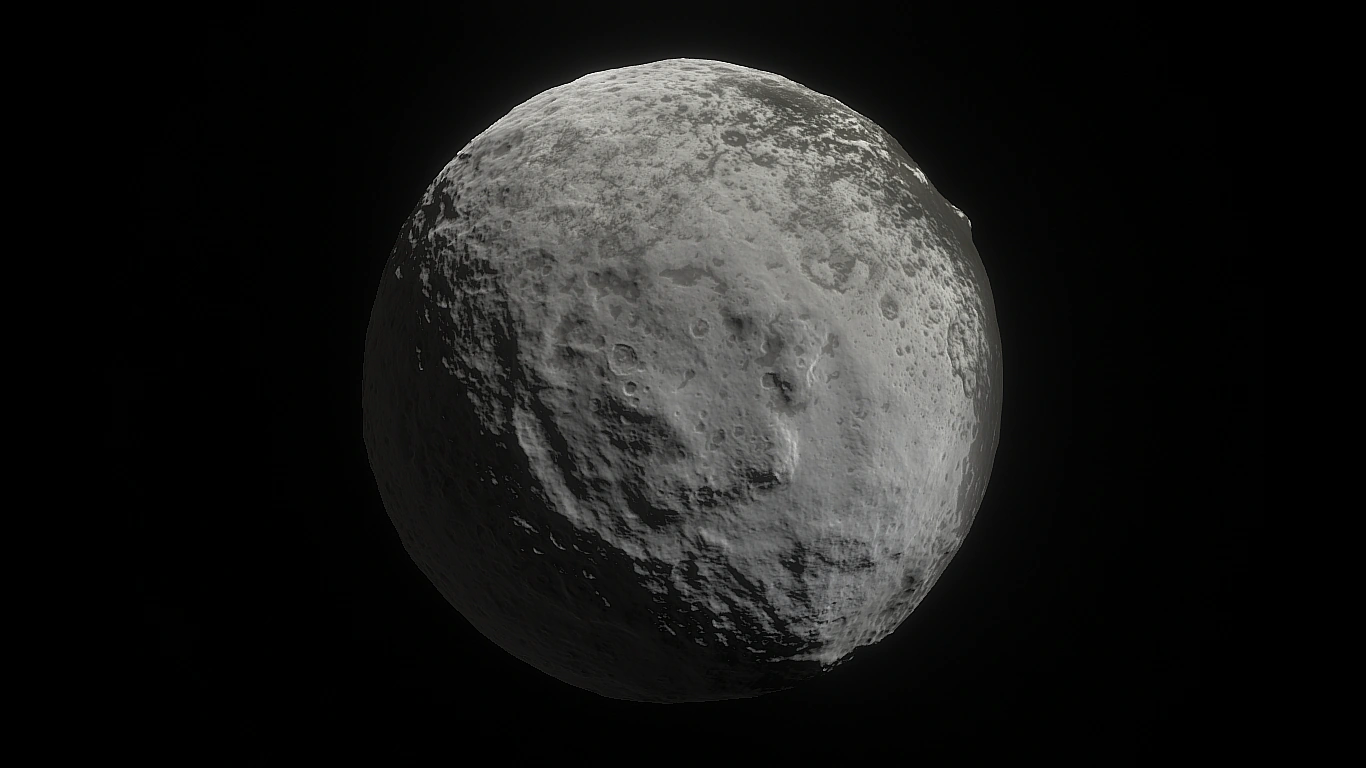
Iapetus is the outermost major moon of Saturn. It is the 11th-largest moon in the Solar System and notable for having a strong two-toned surface coloration; due to its appearance, it is sometimes called the "Yin-Yang" moon, with half of the moon being very dark and the other half being very light, and for its tall equatorial mountain ridge, which oddly enough is only on the dark side of the moon and for its brighter half being pretty much non-existent.[1]
Formation
The newborn Saturn was enveloped by discs of material that, when the younger Saturn gained hold, the material gradually formed into Iapetus and the moons of Saturn.
Orbit
Iapetus orbits around Saturn every 79.298 days, and it orbits Saturn at a distance of about 3477899.86 km, but what's bizarre is that Iapetus' orbital inclination is unusually high; unlike Jupiter, which has four big moons in more regular, low-inclined orbits, Iapetus' high orbital inclination is not easily explained by co-accretion alone. One explanation says that Iapetus is a captured dwarf planet like Neptune's moon Triton, but that is unlikely because the orbital eccentricity of Iapetus is comparably low at about 0.028. Another theory suggests the cause of Iapetus' highly inclined orbit is an encounter between Saturn and another planet.[2]


Iapetus inclined orbit, shown in red
Internal structure
Similar to all major moons of Saturn, Iapetus has a solid icy envelope taking up 28.5% of its mass, giving it a low density of 1.294 g/cm3. Approximately 34.7% of Iapetus' mass is a silicate mantle, and about 36.8% is made of a metallic core.
Iapetus geological features and origin
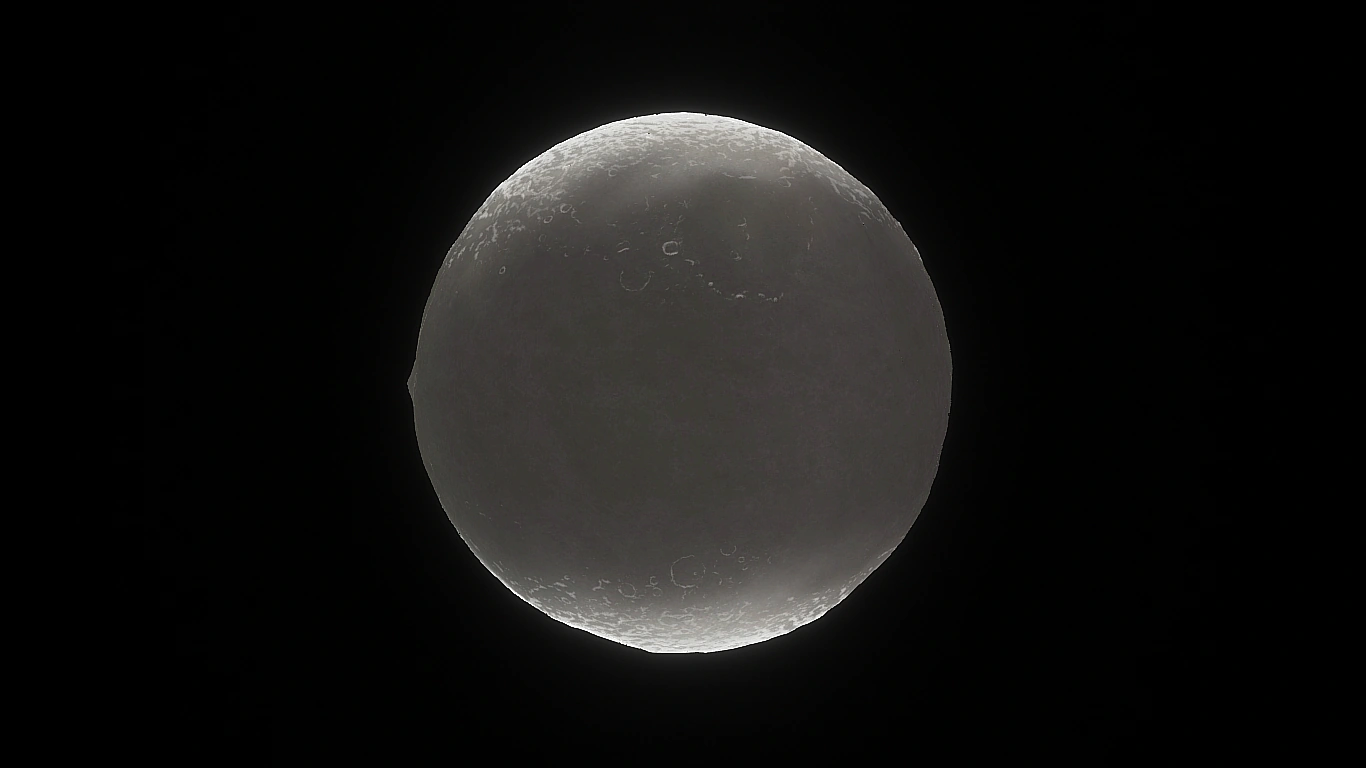

Cassini Regio, Notice the Equatorial ridge at the left.
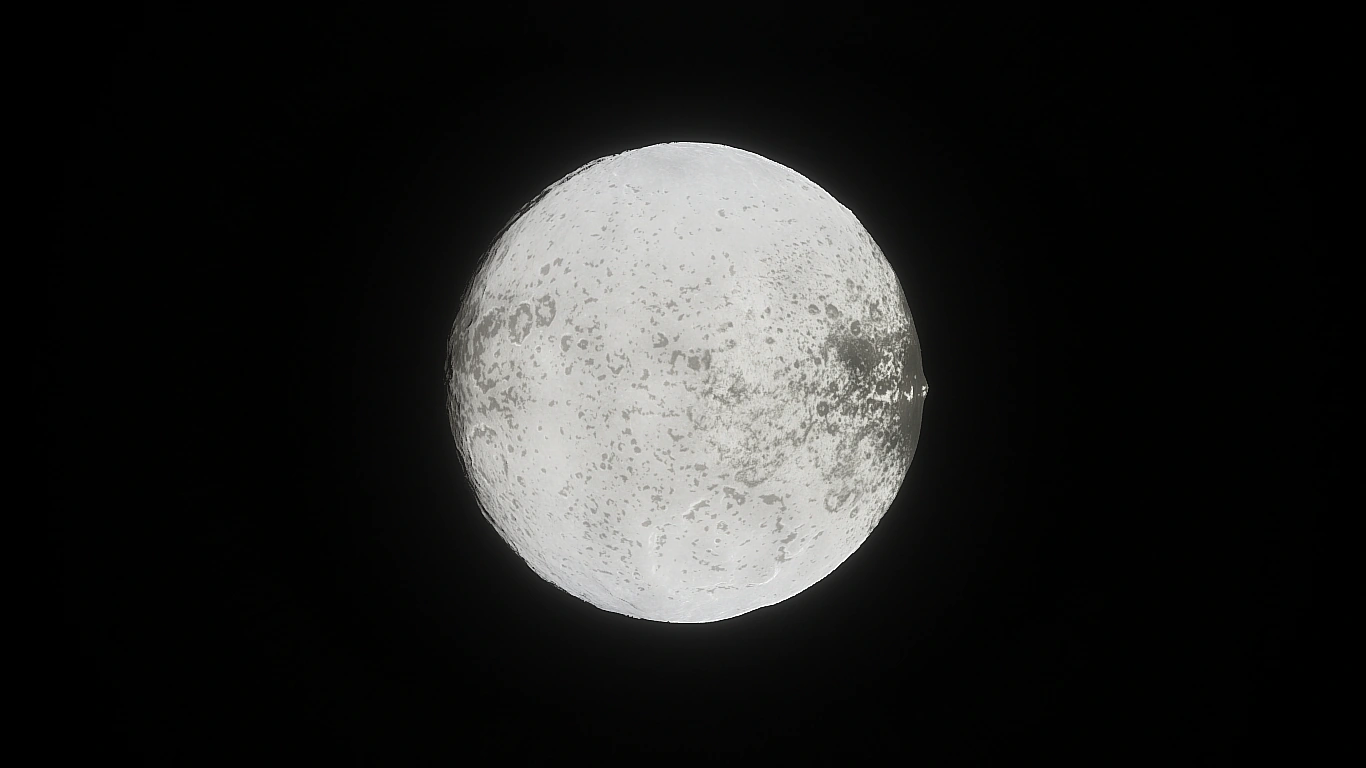

Roncevaux Terra and Saragossa Terra, Notice the Equator ridge from the right.
Iapetus has a heavily cratered surface with two unique colorations; the leading hemisphere has a strong different color named Cassini Regio; its color is brownish-black with a hint of red; it is quite thin, while the trailing hemisphere has two named regions, Roncevaux Terra is a northern part of the white side and Saragossa Terra is the southern part of the white side. Both of the regions are highly reflective, and Roncevaux Terra and Saragossa Terra are believed to be the primary colors of Iapetus, while the Cassini Regio may have originated from a material that has obscured the brighter ice on the surface of the moon with Phoebe dust. One of the noticeable features of Iapetus is the Equatorial Ridge of Iapetus, which runs almost perfectly along the equator of Iapetus, covering a distance of 1,300 km (807 mi) long, 13 km (8 mi) high, and 20 km (12 mi) wide. The ridge itself has some heavy cratering, indicating that it's old as the moon. It's puzzling why the Equatorial ridge ends when the bright regions start, but some hypotheses may explain Iapetus' Equatorial ridge.
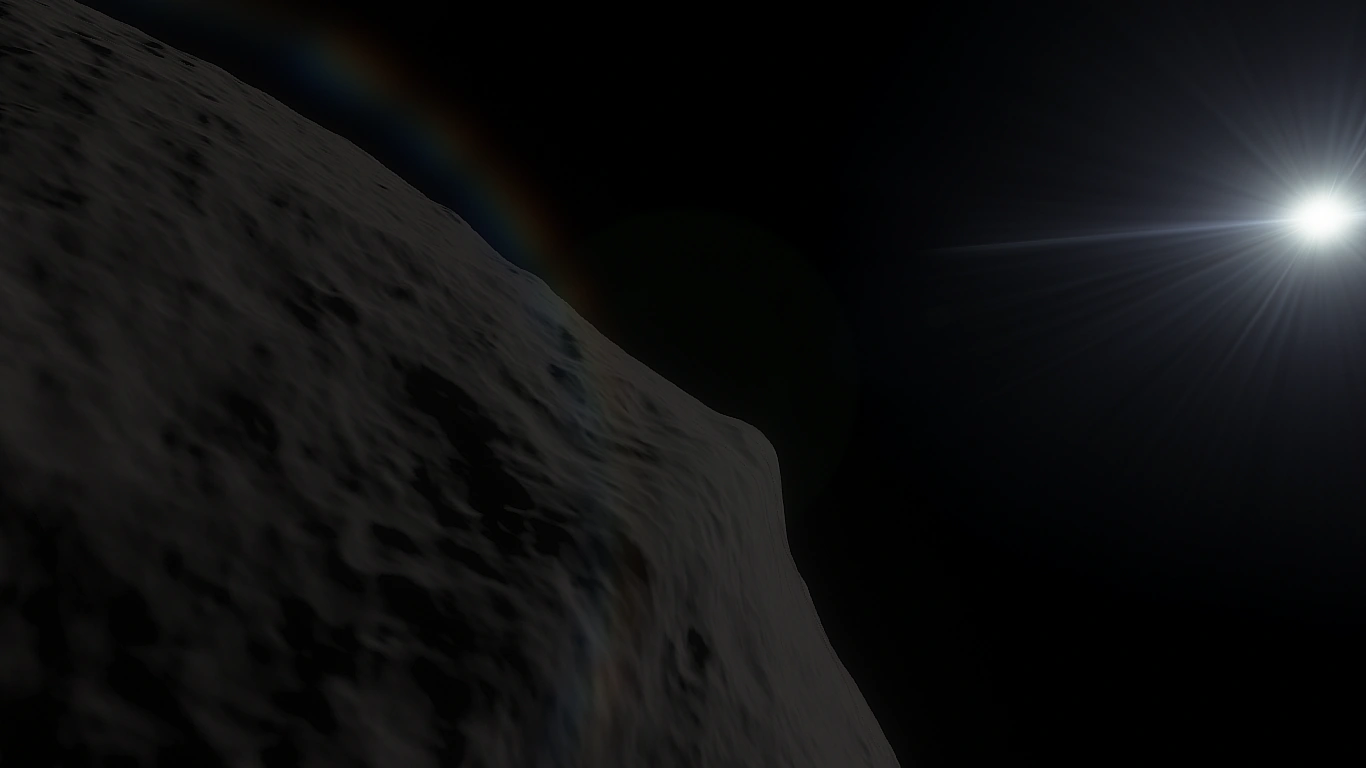

The Equatorial ridge
The ridge could be a holdover from Iapetus' oblate shape when it was younger and spun at a rotational period of about 17 hours more than it does now. If Iapetus was heated by the radioactive decay of aluminum-26 and then cooled quickly enough to preserve the ridge while remaining plastic for long enough for Saturn's tides to slow the rotation to its current tidally locked 79 days, then it must have been heated by the radioactive decay of aluminum-26. This isotope appears to have been widely distributed in the solar nebula where Saturn formed, even though it has since decayed. Based on the quantities of aluminum-26 required to heat Iapetus to the appropriate temperature, it is evident that Iapetus developed far sooner than expected, only two million years after the asteroids first started to form.[3]
Because of Iapetus' huge hill sphere, Iapetus may have had a ring system at some point, and the collisional accretion of this ring may have formed the Equatorial ridge.[4]
Because of the huge hill sphere indicated above, Iapetus might have been impacted by a body that produced both a ring system and a subsatellite. The subsatellite then swiftly forces the ring system down onto Iapetus, forming the ridge system, before leaving Iapetus' gravitational pull by tidal acceleration.[5]


Turgis and Malun near the terminator line

_and_the_landslide.png)
Malun's 15 km scarp (9.3 mi) and the landslide

Engelier and Gerin
Following the Equatorial Ridge further, we notice that the Equatorial Ridge has been obliterated by the Turgis impact crater. With a diameter of 580 km (360 mi),[6] Turgis is the biggest impact crater on Iapetus,[7] while Abisme is the second-biggest crater. Located at the bottom-left corner of Turgis, Malun is an impact crater that has caused a scarp to extend for roughly 15 km (9.3 mi)[8] and a landslide. The Engelier crater partially encircles the 445 km (276 mi)[9] in diameter Gerin impact crater, which is situated in Saragossa Terra. It is 503 km (312 mi)[10] long, 8–9 km deep,[11] and almost half of Gerin was decimated during its creation. The Equatorial Ridge made an appearance again near the border of Roncevaux Terra and Saragossa Terra, but the Equatorial Ridge did not exist where whiteness predominated throughout the area.
Gallery


- ↑ https://en.wikipedia.org/wiki/Iapetus_(moon)
- ↑ https://www.semanticscholar.org/paper/EXCITATION-OF-THE-ORBITAL-INCLINATION-OF-IAPETUS-Nesvorn%C3%BD-Vokrouhlick%C3%BD/d67e173f98800205ac98ba8410cd7792f518b3dd
- ↑ https://www.science.org/doi/full/10.1126/science.311.5757.29
- ↑ https://agupubs.onlinelibrary.wiley.com/doi/full/10.1029/2005GL025386
- ↑ https://www.sciencedirect.com/science/article/abs/pii/S0019103511002041
- ↑ https://planetarynames.wr.usgs.gov/Feature/14488
- ↑ https://planetarynames.wr.usgs.gov/Feature/14488
- ↑ https://www.jpl.nasa.gov/images/pia06171-giant-landslide-on-iapetus
- ↑ https://solarsystem.nasa.gov/resources/143/global-view-of-iapetus-dichotomy/
- ↑ https://solarsystem.nasa.gov/resources/143/global-view-of-iapetus-dichotomy/
- ↑ https://www.sciencedirect.com/science/article/abs/pii/S001910351100176X