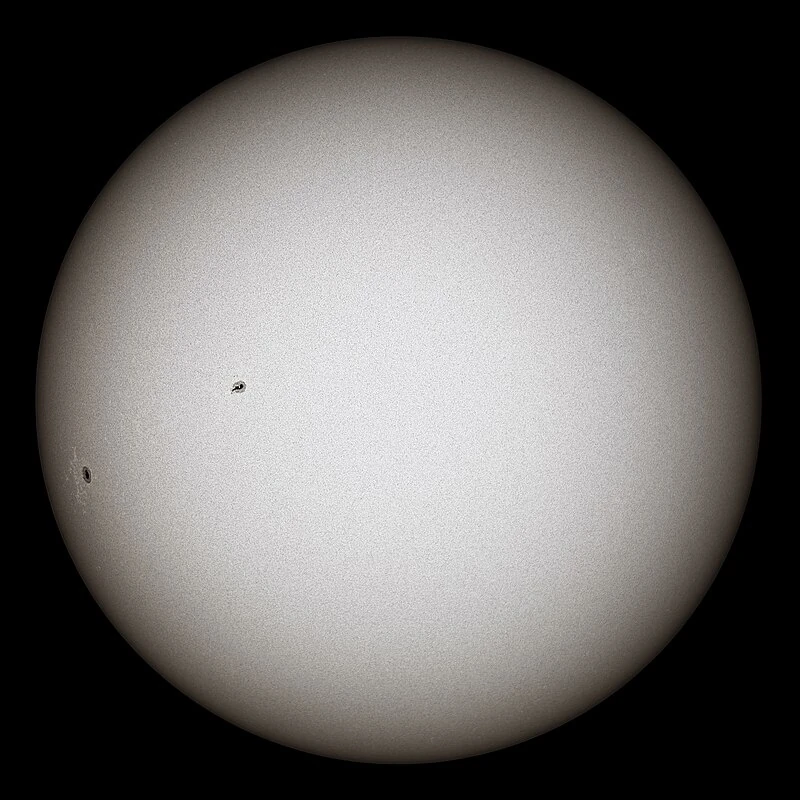

Alara is a temperate Earth-like world, which sits in the habitable zone of its two suns. It orbits a P-type binary star system, given the name of Kronos and Cathal, named after the Greek god of time. It is the second planet orbiting in its system, out of 6 total planets. This world has 16 moons, 14 of which are just captured asteroids, and two being large spherical moons. This beautiful ringed world is home to some of its galaxies most colorful plant life, along with a very diverse ecosystem consisting of over 30 million species of organisms. Alara's ecosystem consists of all types of organisms, marine, terrestrial, subglacial, aerial, and is home to a curious intelligent race, similar to humans on a technological level, but are very interested in Astronomy. The planet has an ESI rating of 92.5%, or 0.925.
(WIP | THIS ARTICLE IS NOT FINISHED UNTIL THIS NOTICE IS REMOVED)
Planet Information
Alara is an oceanic Earth-like world, similar to Earth although it is 1.1 times the radius of Earth, having a diameter of 14998 km, and also being more massive than Earth, with a mass of 1.9 Earth masses. The higher mass causes its gravitational pull to be higher, having a surface gravity of 13.6 m/sec2, or 1.387 g. Alara is seismically active and has moving continents along with a molten iron core that spins, producing a very strong magnetic field. The core is 30.8% of the entire planet's mass, and the silicate crust makes up the rest. Alara's surface is 78% ocean, with the other 22% being dry land. Most continents are shaped like islands, and barely and of them connect. They are all almost separated by an ocean. Alara's orbital period is similar to Earths, taking only 321 days to complete an orbit. Because of the planet's 27-degree axial tilt, seasons are very prominent, although they are slightly shorter than Earths. The pressure on the surface of the planet is 17 times greater than Earth, with the surface PSI being 254 PSI. The surface would not be survivable to humans, but the atmosphere is breathable if humans could withstand the pressure. The atmospheric composition of Alara's atmosphere is 79.5% Nitrogen, 15.8% Oxygen, 3.32% Water vapor, 1.39% Carbon dioxide, and the rest consists of heavier elements like SO2, Argon, and CO. The magnetic field is more powerful than Earths, keeping the planet shielded from the radiation from its two suns, and combined with its atmosphere, keeps the temperature habitable throughout its orbital cycle. One day on Alara is only 13 Earth hours, making the planet spin quite fast. Alara has 16 moons, and 2 of them are large moons, both similar to our moon in diameter. Both moons orbit relatively close to the planet, which have drastic effects on the tides. They cause the tides to rise and fall variously, ranging from 2 meters a day, to 7 meters a day. The other 14 moons are just small dwarf moons, which do not contribute to the effect on Alara's tides. Even though the planet is larger than Earth, the air density and similar atmospheric composition allow for sound to travel at 343 meters per second, surprisingly the exact same speed as on Earth. The tropopause is 17.56 km above the surface, and the atmosphere height in total is 58.53 km, which is higher than Earth's own atmosphere. The last thing to note is that Alara is only slightly older than Earth, only being 5 billion years old.
History
- 5 billion years ago: Alara forms from a condensing cloud of material through accretion.
- 4.9 billion years ago: Alara is hit by another planetoid, around half the size of Alara. The collision forms a large ring system around the planet, and the extra debris reforms into two large moons.
- 4.7 billion years ago: The planet cools and the moons enter circular stable orbits, a few other smaller moons form within the rings of Alara.
- 4.6 billion years ago: Alara's core begins to spin due to the planet's fast rotation, which generates a powerful magnetic field over hundreds of thousands of years.
- 4.4 billion years ago: Alara's days are only 6 hours long, and the axial tilt is stabilized by the moons as their gravity begins to slowly slow the planet's rotation.
- 4.3 billion years ago: Alara's temperature stabilizes at -20 °C and the core begins to spew magma up into the crust, creating the first volcanic activity on the surface.
- 4.1 billion years ago: Volcano eruptions trigger Nitrogen and carbon dioxide levels to rise, forming Alara's atmosphere.
- 4 billion years ago: clusters of asteroids and comets from the asteroid belt are destabilized by the other planets, bombarding the surface of Alara. Most ended up impacting, some were captured and became permanent moons.
- 3.9 billion years ago: Alara clears its orbit from all the debris, most of these asteroids and comets were rich in ice and salt, which evaporated into the atmosphere upon collision with the planet, warming its average temperature to 50 °C, also due to the atmosphere thickening.
- 3.8 billion years ago: the atmosphere of Alara is now mostly water vapor and nitrogen, but the slowly cooling temperature causes disturbances in the atmosphere, resulting in global storms of massive levels, which turn from puddles, to lakes, and then into oceans.
- 3.6 billion years ago: the storms stop after around ~200 million years, and the entire planet is now a global ocean, with oceans slightly saltier than Earth.
- 3.5 billion years ago: volcanic islands rise from the ocean due to continental drift and tectonic activity, which are the first land masses on the entire planet.
- 3.2 billion years ago: Alara forms an ozone layer in its atmosphere, and through Abiogenesis, the first unicellular organisms appear deep in Alara's oceans, feeding off of hydrothermal vents.
- 3.1 billion years ago: more land is pushed above water, creating small continents.
- 3 billion years ago: Some evolving creatures begin photosynthesis and begin to fill the atmosphere with oxygen.
- 2.8 billion years ago: first plankton evolve, which speeds up the oxygen production in the planet's atmosphere.
- 2.6 billion years ago: first multicellular lifeforms, which become predatory, prompting evolution at a faster rate.
- 2.5 billion years ago: a large asteroid collides with the planet which causes a period of volcanism, and the global temperatures rise slightly as the suns are blocked by ash.
- 2.4 billion years ago: the atmosphere is now 22% oxygen, and the first plants begin to inhabit the continents, slowly turning the land green.
- 2.2 billion years ago: the first complex organisms evolve in Alara's oceans, being corals and small fish.
- 2 billion years ago: the first complex organisms reach land and use eggs as ways to reproduce before fully adapting to land.
- 1.9 billion years ago: many more complex organisms evolve to suit forests on land, and life spreads across the surface.
- 1.7 billion years ago: Alara captures lots of asteroids in its orbit, gaining extra dwarf moons, now having a total of 9 moons.
- 1.6 billion years ago: Alara's magnetic field flips, causing radiation levels to increase, causing a mass extinction due to radiation poisoning. The magnetic field stabilizes again after the flip, and life recovers.
- 1.4 billion years ago: Intense solar flares from Cathal (Kronos B) cause a periodic event known on Alara as a "Hyper Aurora" due to Cathal's intense solar storms, Auroras on Alara can be luminous enough to cause small twilight-like periods during these events.
- 1.3 billion years ago: Alara now has a diverse landscape, with jungles, reefs, mountains and deserts, and many more biomes similar to Earths.
- 1.1 billion years ago: temperatures stabilize after billions of years, no longer going through drastic changes, and so does Alara's axial tilt.
- 1 billion years ago: A period of predatory rule, predator organisms begin reproducing too fast, resulting in a predator mass extinction, but most herbivores live and thrive.
- 900 million years ago: Continents shift, forming a large supercontinent, about the size of Asia. The rest of the world is small islands scattered in a large ocean.
- 750 million years ago: the supercontinent breaks apart into smaller land masses and spread out around the planet.
- 600 million years ago: major asteroid impacts, resulting in 87% of all life going extinct. The survivors eventually recover over the next few ten thousand years.
- 400 million years ago: mammals begin to populate every corner of the planet, and the ecosystem becomes mostly stable.
- 350 million years ago: another magnetic pole flip, but this time, most species have adapted to higher radiation levels, so not much happens.
- 200 million years ago: another super continent forms.
- 100 million years ago: the continent splits into the land that is currently present on the planet, although it is slowly drifting back towards each other.
- 80 million years ago: Alara captures its most recent moon, the total now being 16 moons.
- 69 million years ago: The planet is struck by a major asteroid, resulting in another mass extinction that wipes out 78% of life, but it recovers.
- 43 million years ago: continents begin drifting further apart.
- 13 million years ago: The planet is now dominated by mammals and reptiles, being the main two most abundant types of animals.
- 2 million years ago: earliest ancestors of J'kari race, the first species to display signs of intelligence.
- 100,000 years ago: J'kari become dominant, learn how to use tools and make things to alter the environment.
- 14,000 years ago: first J'karian civilization
- Today: Alara is a thriving and beautiful world, home of the J'kari, a race who evolved around astronomy, and taking good care of their home planet.
Geography
Alara's surface is around 78% water, with all continents being quite far apart from each other, but the oceans are home to hundreds of volcanic and also non volcanic islands. Most islands tend to be lush, with plenty of vegetation and great places for ecosystems and coral reefs, while the large land masses host a wide variety of different landscapes, from deserts to mountains to sulfuric acid pools, The surface of the planet has been well studied by the J'kari. The most common landscapes on Alara are large forests, due to the amount of time life has had to spread across the surface and the warm and good conditions around these land masses. Volcanoes tend to be towards the equator of the planet, which is where it is warmest. The deserts of Alara are hot and dry, with beautiful golden sand dunes which can be up to 100 meters high, made from nothing but pure sand. Large grassy plateaus also exist around deserts, being large flat lands with spread out trees and very grassy plains. One of the most notable features of Alara's surface is its large mushroom forests, which span across the entire planet and can be found mainly near the equator. Also, around the equator, where the temperatures are warmer, and the land is wet, great marshlands and massive jungles grow, on the side of mountains, in large flat areas and other areas are completely shrouded in jungle, along with islands around the equator too. J'kari cities are also present on the planet, but they plant trees and other vegetation to keep the environment as natural as possible. Below the surface of Alara lies large quantities of quartz, with caves often leading to caves of hundreds of large quartz crystals. Along with quartz caves, gold geodes and emerald geodes are common throughout the caves, with these caves providing a lot of valuable resources to the J'kari, along with just being very pretty and making up another one of Alara's cool geographical aspects. Back to the surface, some areas with natural geological activity have natural hot springs, which are good vacation spots and also pretty surface features.
Moon system
Alara has a total of 16 natural satellites, but only two of them are vital to the planet's habitability, these two moons being Hathor and Aneteka, both of which are smaller than Earth's own moon. These two moons play a vital role in stabilizing Alara's axis, and also being a natural deterrent for asteroids. The moons formed 4.9 billion years ago after a large planetoid struck Alara, and the debris collected together into these moons. The other 14 moons are small asteroid sized moons, most of which were captured billions of years ago, but the J'kari believe that these moons are rich in natural resources such as gold, copper, silver, iron, and other valuable metals. Hathor is the largest moon of Alara, and the one which has most influence over the tides on the surface. Hathor only orbits at a distance of 83,000 km, and Aneteka orbits closer, at a distance of 43,000 km. They are very large and reflect a lot of light, making nights on Alara quite bright if one of the two moons are visible in the sky. The J'kari named these moons after deities in which they worship, being powerful overlords who ruled the sky and struck down any J'karian who caused trouble, which was the belief in ancient times, although in the modern day, these are just folklores and stories told to each other and to young J'karians who misbehave. Both of these Alaran moons have small colonies on them, with small populations that leave and stay, there are no permanent residents on these moons, all of them are scientists who are trying to understand these moons history and build space stations to move the J'kari to another planet and become a multiplanetary species. Hathor is slowly drifting away from Alara, at a rate of one millimeter per Alaran year, which is a consequence of Alara's very fast rotation, meanwhile Aneteka is not moving away, since it orbits Alara almost as fast as the planet rotates, so it is not accelerated into a higher orbit.
The Minor moons
Alara's 14 other moons are asteroids, rich in valuable resources which the J'kari plan to send mining equipment to. In ancient J'karian history, these moons were referred to as "wandering stars" due to never having a fixed position in the sky, ancient J'karians believed they were stars which were wandering through their night sky. These dwarf moons are believed to have been captured billions of years ago and were pushed out of their orbits from gravitational forces of other planets. These asteroids eventually found their way and crossed paths with Alara, becoming captured by the planet's own gravity. Further study of these asteroids found that they are rich in valuable metals, and water as well. The dwarf moons do not orbit the same way as the larger moons, they are much farther from Alara than the larger moons, although 2 of them orbit between the orbit of Hathor and Aneteka, and one orbits within Alara's rings. The other 11 moons orbit much farther and have very inclined orbits, as well as orbiting in the opposite direction. The strange orbits are due to the fact that again, they are captured moons, and not naturally forming moons from the early days of Alara's formation.
Origin of Life
Life on Alara has been though to originate 3.2 billion years ago, not too long after the planet's formation. The J'kari have designated that abiogenesis was the origin of life on the planet, and the first organisms were probably small single celled organisms which converted sunlight into sugars, which kept them alive. (Abiogenesis has thought to be the most common way life evolves on planets or moons, being the origin of life on Earth and the origin of life on most planets in the universe.) They also reproduced asexually, like more complex cells they create more of themselves through binary fission. (Or just splitting in simple terms) After some time some of these organisms became predatory, similar to how white blood cells kill viruses in more complex life. The prey organisms eventually evolved to work using multiple cells, birthing to a whole new area of organisms and opening the door to complex life. Over the next few millions of years, more and more types of organisms evolved deep in the oceans of Alara, some feeding off of hydrothermal vents, some consuming sunlight and releasing oxygen, and some eating others for sustenance. Plant life eventually sprouted near the shores of Alara, which paved the way for more complex life to exist on the land in the future. The plants have been thought to get to land using Algal mats, which are like watery mats of algae, which fertilized the soil on Alara, allowing the first tiny plants to grow, and eventually these plants became bigger and bigger, creating grass, fruits, vegetables, flowers, roots, trees and other essential ingredients for life to live on the surface. Some plants also evolved to live in water, which created the reefs which are present near a lot of Alara's coastal cities and other remote areas today. Soon more complex organisms would crawl out of the oceans of Alara, but some species began to evolve spores which had a lighter weight than water, allowing them to float out of the water and cloud the sky with large clouds of spores. These clouds created Alara's beautiful mushroom forests that are one of the most notable aspects of the surface today. Without the complex biological history of Alara, life on this planet would never be as diverse as it is today, and Alara's biosphere is a complex and fragile balance, with ingredients constantly recycling nutrients, keeping this balance stable. There are many other theories created by the J'kari on where life came from, as they too do not fully understand the origins of life or their species, but they strive to understand as much as they can about themselves and their planet's environment. Alara's life has over time greatly diversified, allowing the biosphere to have different biomes, which are inhabited by comparatively similar plants and animals. The different biomes developed at distinct elevations or water depths, planetary temperature latitudes and on land also with different humidity. Alara's species diversity and biomass reaches a peak in shallow waters and with forests, particularly in equatorial, warm and humid conditions. While freezing polar regions and high altitudes, or extremely arid areas are relatively barren of plant and animal life.
Biosphere
The biosphere is made up of the parts of Alara where life exists. The biosphere extends from the deepest root systems of trees to the dark environment of ocean trenches, to lush rainforests and high mountaintops. J'karians describe Alara in terms of spheres. The solid surface layer of Alara is the lithosphere. The atmosphere is the layer of air that stretches above the lithosphere. Alara's water on the surface, in the ground, and in the air makes up the hydrosphere. Since life exists on the ground, in the air, and in the water, the biosphere overlaps all these spheres. Although the biosphere measures about 20 kilometers (12 miles) from top to bottom, almost all life exists between about 500 meters (1,640 feet) below the ocean’s surface to about nine kilometers (5 miles) above sea level.
Classes of Life
J'karian biologists decided to split organisms into categories, consisting of Plants, Animals, Reptiles, Insects, Amphibians, Fish, and Spores. These categories were created to make it easier to separate and classify types of life, allowing for easy teachings to young J'karians and also keeping things neat and organized.
Plants
Plants on Alara are similar to plants on Earth. Most live via photosynthesis, converting sunlight into sugars, and releasing oxygen. Most plant life is green, due to Kronos' light being much more powerful than its smaller, red dwarf companion. Plants change color based on the seasons, during summer and the hottest months, plants will be bright green, dark green, and lime, with flowers and fruits, and seeds, and lots of reproduction happening during these months, during fall plants like grass and trees will change to deeper colors such as red, purple, blue, and yellow. The darker colors are due to the redshifted light from Cathal, even though more light comes from Kronos. During the winter all leaves and plants will lose their leaves and become in a dead state much like plants on Earth. This is to conserve nutrients to be able to survive to the spring. During the spring finally, is when everything sprouts, and life begins to replenish all of its color due to the soil becoming damper and more nutrient dense. Most plants on Alara are similar, but the mushroom forests are much different, as they absorb nutrients from dead matter as well as nutrients from the soil. These mushrooms can live throughout the years, but release large amounts of spores during the summer, which attach to some creatures, and they carry them around to other places, much like pollination. During "Ring season" (Ring season is when Alara's rings cast a shadow on a certain part of the planet, although this shadow is constantly moving due to Alara's inclined orbit and axial tilt) Plants will enter their winter mode, because the shadow of the rings can drop temperatures on that region of the planet by 20 degrees Celsius. Due to Alara's 130% Earth gravity, trees are shorter, and so are a lot of mushrooms as well but these trees and other plants have evolved for millions of years to overcome these gravitational forces and grow to pretty great heights. The tallest trees on Alara's surface can reach altitudes of 75 meters. While trees, shrubs and flowers are incredibly diverse on Alara, wild fruits along with vegetables are also a delicacy on this planet, consumed by the J'kari and by millions of other animal species. Most fruits contain large pit seeds in the middle, due to them not being able to go far due to the high gravity, although some berry species can travel large distances using other creatures, and some seeds aren't digested and are spread by being pooped out by other animals. While this is mostly true with vegetables too, some grow from fully ripe vegetables, similar to potatoes or carrots here on Earth. There are hundreds of thousands of different fruits and vegetables, making for a wide variety of different plants and flowers. Some plants are carnivorous, such as the large dipper plant, which is a pitcher like plant, capable of digesting large mammals and can grow to sizes almost as large as a J'karian.
Animals
Due to the increased surface gravity of Alara, most animals on this planet have very thick bones, allowing for easy movement around the surface of Alara. Alaran mammals and animals are also all very furry, due to the rings which periodically cast shadows on the planet, constantly changing which can last for weeks or even months at a time. The fur allows them to keep warm during the freezing temperatures of ring season. With thicker bones also comes greater strength, as a result most animals are very strong and are capable of damaging other animals that invade or are a threat to them. A good example of an animal that has great strength is the Quinrin, which is large, cat-like animal that has very sharp teeth, and are also quite large, and have very large hind legs, allowing for a powerful kick. The Quinrin are present in a lot of Alaran ecosystems, being an apex predator and keeping a natural balance, preventing overpopulation with their prey items, although they tend to leave the J'kari alone or avoid their habitats, as they usually don't win in a fight against the J'kari. Another prime example of Alaran predators is the Gata, which are basically large red panda like creatures with a venomous saliva, capable of stopping a prey animal's heart within one minute of being bitten. They also hunt in groups, being able to take down animals much larger than themselves and they also live amongst the tall canopies of trees. They are incredibly deadly but have a mutual relationship with the J'kari and the Quinrins. A lot of animals hunted by predators and apex predators are herbivores, some being very large, while others are small, and are targets of smaller predators. One animal that can never catch a break is the pyradear, which a creature with a large torso, a mane for attracting mates, two powerful front arms and hind legs that are capable of allowing the animal to walk on two legs. They use their strong front arms to fight off predators, and when in groups this can work, but often times they are caught off guard and ambushed without the backup of their groups. Pyradear are herbivores, eating grass, roots, fruit, seeds and leaves from trees and plants. They are usually docile and will avoid interaction with other large animals but stay with their groups. Alaran birds are also all over the planet, many of them being small and herbivorous, while some are large and can eat large animals.
Reptiles
Alaran reptiles are classified by the J'karians into groups; small and large, smaller reptiles range from the size of a penny to the size of a watermelon. Like mammals and animals, most reptiles have a thick coat of fur to protect them from the freezing temperatures during Alara's ring season. Most small reptiles are capable of flight due to millions of years of evolutionary traits, but they do prefer to live on forest and jungle floors where it is lush and protects them from predators. Small reptiles' main predators are Alaran birds, which are highly skilled hunters and have great eyesight. Small reptiles have camouflage, poison, and also have evolved mimicry to escape predators. One special species of reptile is the exploding yamic, which is a small, lizard like creature has one of the most unique defenses of all animals on Alara. When threatened, they are capable of launching their sharp scales at high speeds, which upon impact explode like a small snapper firework, which can hurt most animals, making them back off. In some cases, their scales can take down large birds and even large mammals if they hit the right spots, making them a very dangerous reptile to hunt. J'karians have also had trouble with studying them due to their explosive nature. One downside of having explosive scales is that sometimes when the reptiles fall or stumble, scales will explode and trigger a chain reaction due to the high atmospheric pressure, which is what allows them to have explosive scales in the first place. Larger reptiles can be as big as blue whales, but they are mainly marine based reptiles, which can come on land but prefer the deep ocean where they have no predators, and feast on algae and bacteria. Other large reptiles that live on land usually live in the desert, where they can hunt other small reptiles or mammals, and even insects. One species in particular, the Oglian Cystala, which lives in the vast deserts of Oglia, is a large reptile that can bury itself into the sand to hunt large mammals that live in the desert. It also buries itself to cool off, and to conserve energy. It kills prey by dragging it into the sand, where it suffocates and eventually dies, but the Oglian Cystala has two long antennae, which can extend upwards of up to 50 feet which stay above the surface, resembling a plant, which they use to breathe when hiding. The vast number of reptiles allows the ecosystem to flourish and remain in balance.
Insects
Most insects on Alara are Hexapods, having 6 legs and are relatively small. A lot of insects are also covered in fur, like most species on Alara. This fur allows them to stay warm during ring season and winter, which is when most insect species find partner to reproduce with. Fur is a very important evolutionary trait among Alaran organisms. Some can fly and others can dig. A lot of insects resemble beetles, with hard exoskeletons and wings. They usually eat plants, smaller insects, and sometimes even members of their own species. They fight with one another for food, water, and mates. One of the most interesting insect species on Alara is the Quartz worm, which are many different species of worms which live in Alara's large quartz caves, eating the actual quartz for sustenance. They live in groups of thousands, even hundreds of thousands. They never actually eat the entire crystal, but they leave really cool patterns in the crystals which are often sold by the J'kari as gifts and decorative items. These worms also eat other minerals, but it is not often that they are found in any other mineral besides quartz. Larger insects are usually venomous and can be very deadly to J'karians and other animals. One species of hexapod called the Tivoli, which is a spider-like insect capable of releasing cyanide gas from an organ in its abdomen. It doesn't often use this as a hunting tactic, more of a self-defense mechanism. These insects are also kept as pets by the J'kari, as they are intelligent and can be trained to be great companions, despite their deadly nature in the wild. They are no bigger than a tarantula and can be found in tropical countries and continents on the Alaran surface. Other insects can be a nuisance in J'karian homes, causing damage to property and are hard to get rid of due to their fast reproduction rates and love for eating J'karian made objects. Insects are also the most diverse species of organisms on the planet with their being almost 4 million species of them, they are never hard to find, and always very interesting to study.
Fish
J'kari
The J'kari are the most intelligent species on Alara, being a civilization only around 50 years more advanced than humans. They are tall, slim and strong beings, resembling humans, with long arms and legs, 2 large circular eyes, having much better vision than us and also having very sensitive ears, which allow them to hear 7x more powerful frequencies than us humans. They are also covered in fur, like apes on Earth. The fur was primarily evolved to protect them from when the shadow of Alara's rings cast upon their towns and cities, their coat thickens during the ring season and during winter, and it becomes thinner during the summer and spring, when the weather is much warmer. They are capable of communicating with each other through language, allowing for easy communication with members, as well as making literature for others and exchanging ideas about how problems can be solved, and also capable of critical thinking and decision making. They are also emotionally intelligent, being able to experience emotions much more powerful than any species that lives on Alara. They are innovators, always trying to find ways to make life better for themselves and for others and trying to find ways to expand beyond the atmosphere of their planet and expand up to the stars. The J'kari as a species are around 2 million years old, evolving from long forgotten ancestors that used to roam the planet. They are fascinated with the stars and with astronomy, with most of their social and cultural constructs being based on the sky.
J'karian History
The J'karians as a civilization are around 14,000 years old, although they have existed for much longer than 14,000 years, their first ancestors dating back to as far as 2 million years ago. They started their Calander when the first permanent temple was built, which is the oldest structure on the planet, and is a very protected site. The temple is called "Oma", meaning beginning, in their main language. This is an overall timeline of their modern history.
- 14,138 years ago: "Oma" was built, the very first J'karian structure built with the intention of being permanent.
- 13,956 years ago: the first J'karian town to be built by old J'karians, and also the oldest town on Alara, named "Asip"
- 13,455 years ago: the first widely known J'karian war, between outsiders and the people of Asip. Though it was small, it was remembered as the first ever war between J'karians.
- 13,009 years ago: the oldest country to still be recognized to the present day is created, being named Oglia.
- 12,985 years ago: second country is created; this one being named "Ushea" It borders Oglia, and the first nationwide dispute happens.
- 12,634 years ago: there are now over 10 countries across the Alaran surface, and this is when the J'karian leader "Efror" was slaughtered and is now worshipped as a god. This is the first, and oldest J'karian religion to be practiced to the present day.
- 9,998 years ago: after a long period of peace, J'karians attempt to make peace with each other and stop wars, although some empires refuse to make amends.
- 9,729 years ago: the first weapon ever invented, the spear.
- 9,532 years ago: the second and most widespread religion is created, still practiced to this day. This religion focuses on the stars, worshipping the stars as their ancestors, and used to be quite brutal, with J'karians sacrificing members low down in society as offerings to the stars. In modern day, items are offered to the stars, as opposed to other living beings.
- 9.282 years ago: The main Oglian church is built, as a place of spiritual worship to be used by Oglian citizens.
- 8,916 years ago: Most of Alara's surface is now separated into countries, with only Islands being left to discover, at this time the J'kari do not know much about where they live, they assume the oceans are "borders" to their world.
- 8,000 years ago: the J'kari don't progress much for ~3,000 years beginning at this point, it is not yet known why no technological progress was made during these three millennia, but it was assumed there may have been a natural disaster or celestial disaster that stunned progress.
- 4,893 years ago: Oglia is invaded by the by the Snasnan Empire, a massive empire that resided within the territory of Ushea, and under Ushean rule.
- 4,234 years ago: Oglia breaks into multiple countries, all fighting each other for more land.
- 3,517 years ago: Shag Thium invades entire continent of Ayai, before it breaks away.
J'karian Geography
Alara is split into continents, and within those continents lie countries, approximately 87 countries are recognized on Alara's surface. Each country has a capital city, and some countries are considered superpowers, leading in technology, medicine, education, and leadership. These countries came to be over hundreds of years and through countless battles and lots of treaties. For the most part, Alara in its present day is at peace with itself, not being many things to fight over anyways, with most countries being known for something, whether it be food, landmarks, interesting history, each country has its own unique history to it, and its own challenges to face politically and economically. Some countries are poor, and some are rich, some are in the middle with average working-class citizens and rich leaders. Some countries are also very important with manufacturing and distribution of products, with countries that have the most natural resources, food, and other necessities being very popular living spots.
Continents
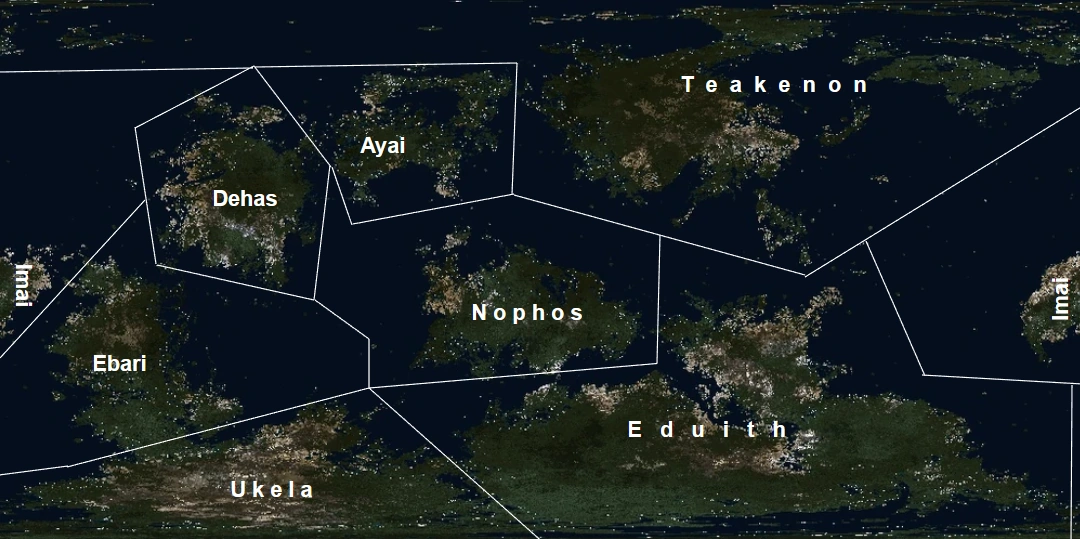
Alara is split into eight continents, as shown below. They are Dehas, Ayai, Teakenon, Imai, Ebari, Ukela, Nophos, and Eduith. The largest Continent by surface area is Eduith, but with many different climate zones and pretty landscapes. Most of the J'karian population lives in the southern hemisphere of the planet, since there is more land below the equator, and also due to being a better stargazing point for interested J'karians, astrophysicists, scientists, spiritual leaders, and religious leaders.
Countries
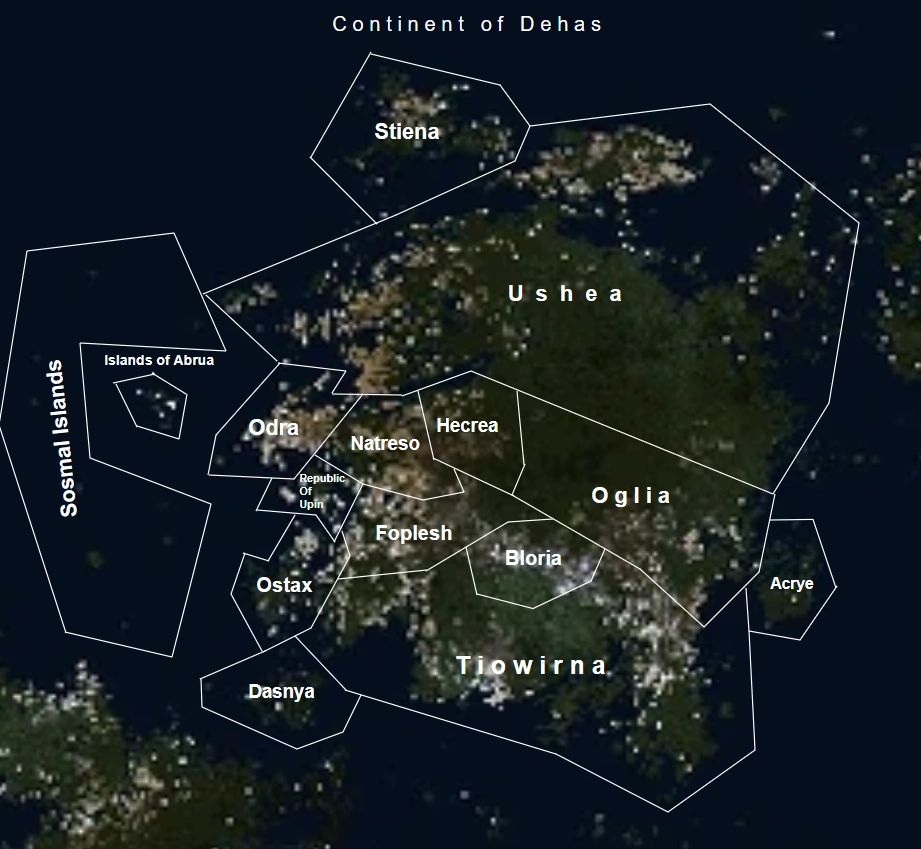
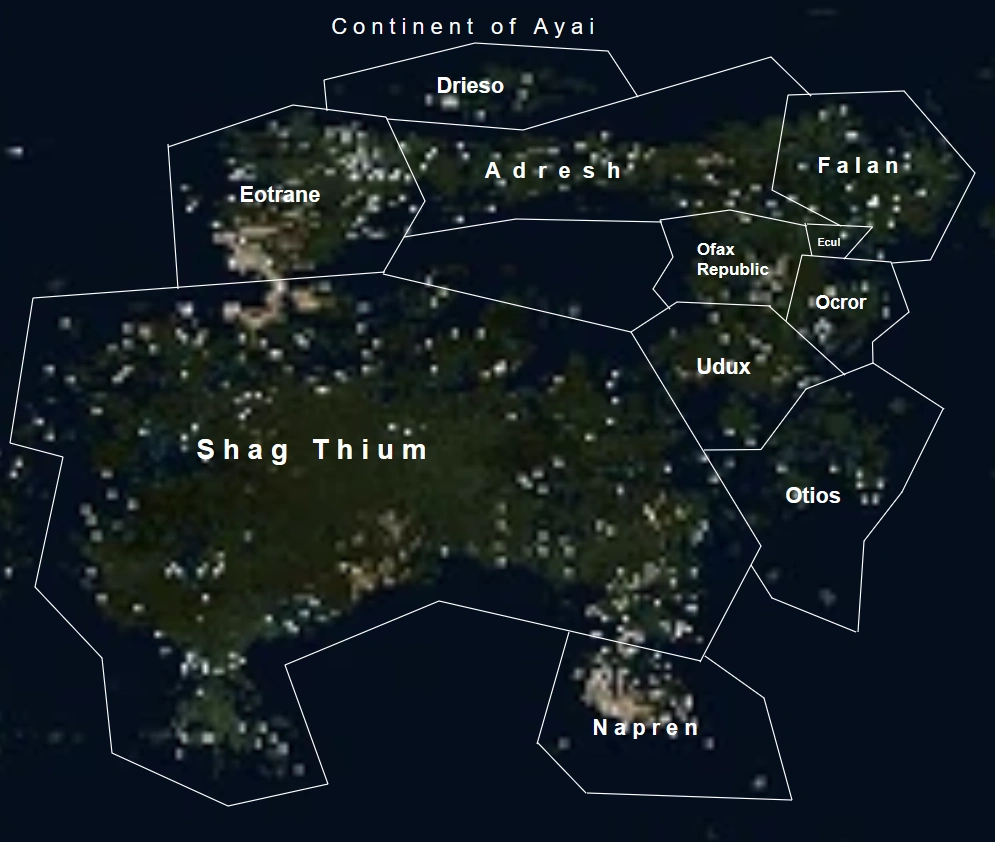
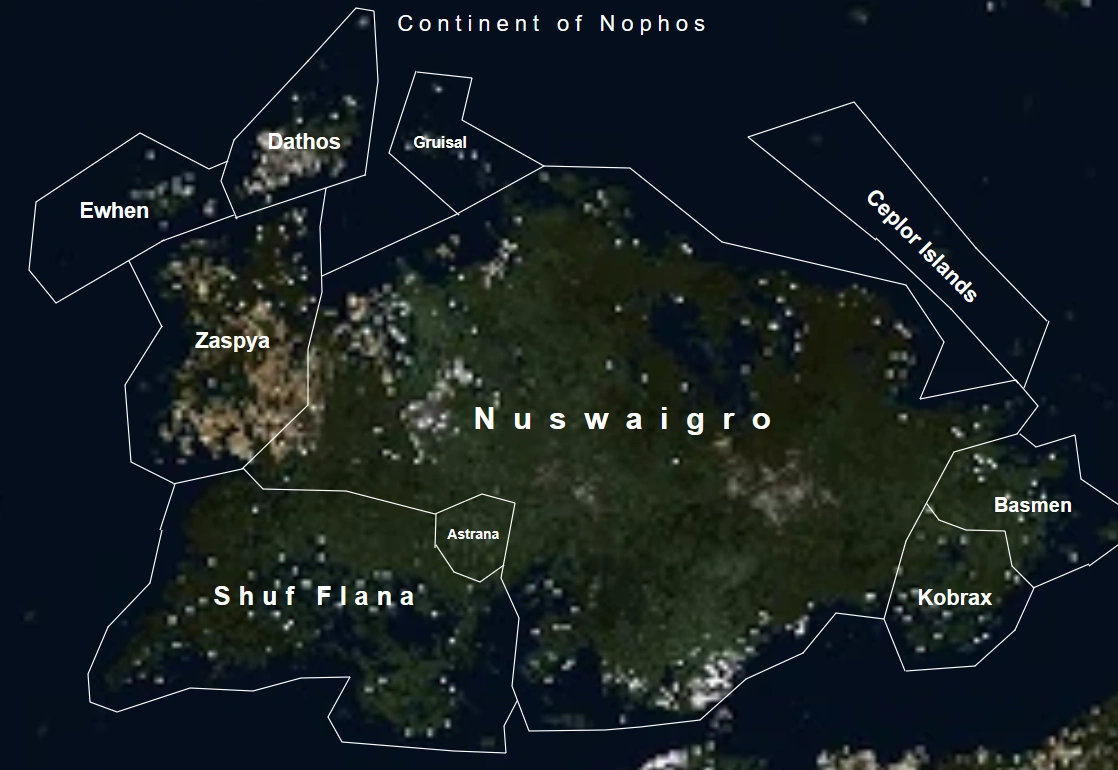
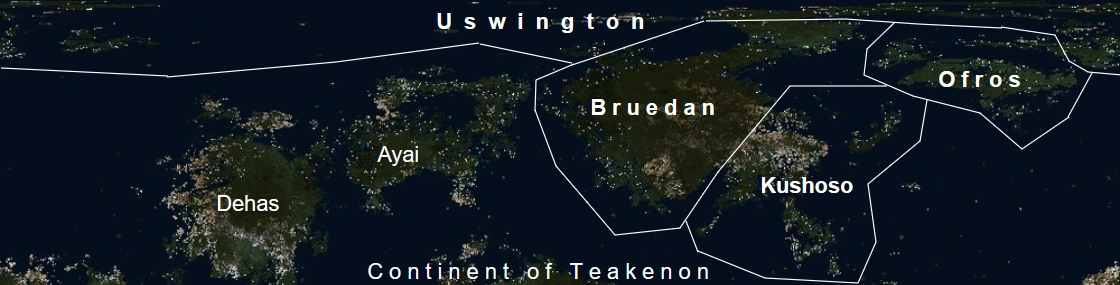
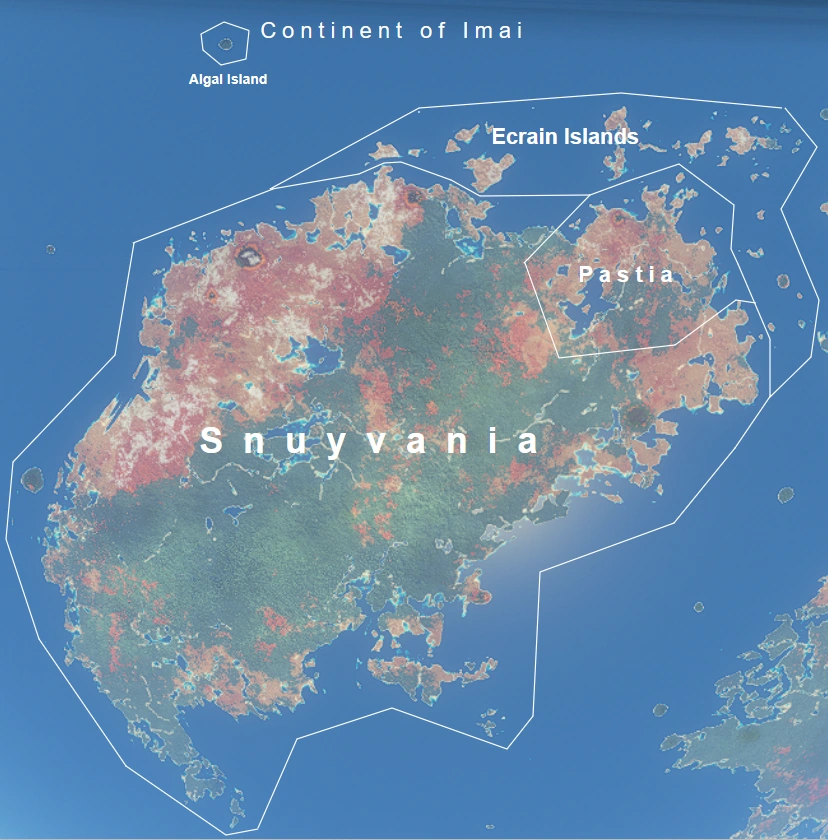
There are currently 87 recognized countries that are on the Alaran surface, with them being named in the images below. Some countries are economic hubs while others are puppet states, controlled by larger governments to acquire resources and control over other regions. The borders may not be fully accurate. Around half of the known countries are also Island nations. The images below show the different countries in each continent.
Culture & Language
The J'kari are a very social species, in terms along with their large brains, it allowed them to develop language and writing skills, which they shared with others to create an array of languages, many of which are native to certain countries. There are over 120 spoken languages throughout the world, and in recent years, a law was passed in all schools that J'karian children are required to learn the most spoken language (which is called Arakou) in order to create a universal language that is spoken throughout Alara. In terms of the other languages, there are many to name and many have been against this language unification as they fear it might eradicate the other 119 spoken languages, but measures are being taken to protect scripts and religious texts along with family traditions to prevent the accidental eradication of the rest of the J'karian languages. Arakou, is the main language spoken on Alara, and is being pushed to be spoken globally, so the J'kari have a chance at leaving their planet and colonizing the rest of their solar system. Arakou is formulated similarly to Japanese on Earth, a subject-object-verb language, which uses symbols instead of traditional writing style used in languages like English or Spanish. There are 53 characters in the Arakou modern alphabet, but traditional Arakou has more than 50,000 different symbols, and is a very artistic language. An average J'karian only knows around 7,000-8,000 different characters, which is more than sufficient for someone to speak fluently. Their language is also tied largely to their culture, naming stars and other astronomical objects, although the planets in the system are named after powerful J'karians who were the founders of modern J'karian history and led the race to win against threats and overcome their enemies. Astronomy and Astrophysics are the most learned subjects on Alara, most graduates celebrate births, weddings, or other special occasions late at night under the light of the stars, hoping one day the J'karians will to be part of their vast galaxy, and beyond. Since the ancient times the stars have been celebrated along with their home planet, preserving the way of life and not damaging their environment, keeping their beautiful ecosystem stable, which is why today, even with all the cities and technology, Alara remains a green, lush and natural paradise for life.
J'karian Astronomy
The J'karian race, like humans are also very curious about what lies beyond their home world, and how they can reach they stars to preserve their species, and even meet new intelligent life within their galaxy one day. Also, like humans, they enjoy discovering and cataloging objects to make it easier for them to identify what they are looking at. Their catalogues are included below. J'karians have been observing the skies since ancient times, believing that the stars were higher beings that they could contact via religious experiences and rituals, although some claim that they have met these so-called gods, research suggests that these are just religious experiences, and not signs of actual gods.
Object Catalogues
ALPS Catalogue (Alaran-Like Planetary Systems)
Gallery


